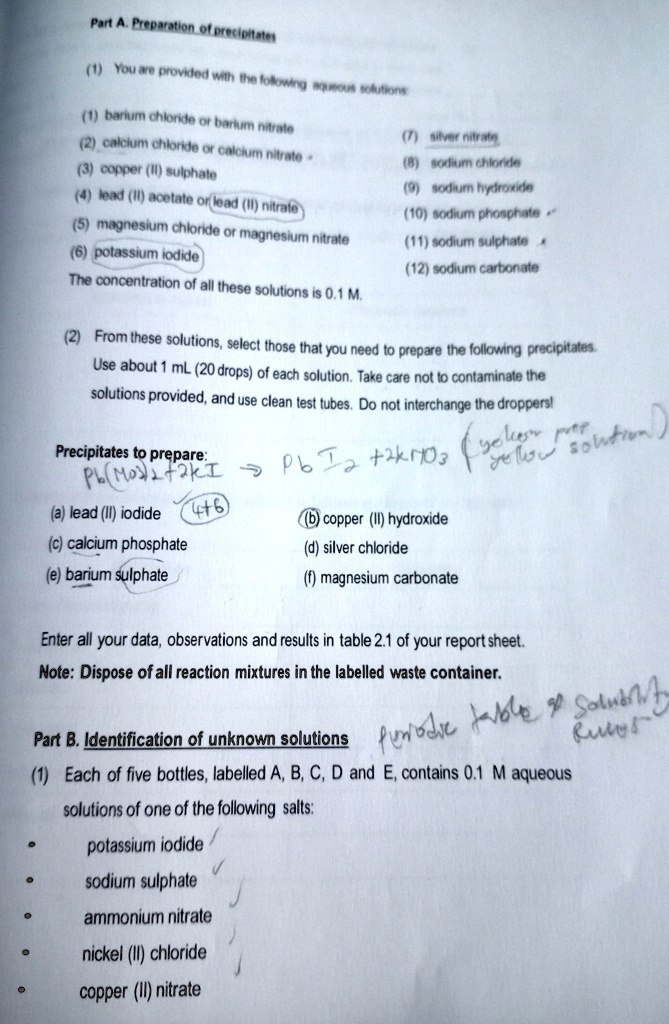
Part A. Preparation of precipitates
(1) You are provided with the following aqueous solutions:
(1) barium chloride or barium nitrate
(2) calcium chloride or calcium nitrate
(3) copper (II) sulphate
(4) lead (II) acetate or lead (II) nitrate)
(5) magnesium chloride or magnesium nitrate
(6) potassium iodide
The concentration of all these solutions is 0.1 M.
(7) silver nitrate
(8) sodium chloride
(9) sodium hydroxide
(10) sodium phosphate
(11) sodium sulphate
(12) sodium carbonate
(2) From these solutions, select those that you need to prepare the following precipitates.
Use about 1 mL (20 drops) of each solution. Take care not to contaminate the
solutions provided, and use clean test tubes. Do not interchange the droppers!
Precipitates to prepare:
$$Pb(NO_3)_2 + 2KI \longrightarrow PbI_2 + 2KNO_3$$
(a) lead (II) iodide 4+6)
(c) calcium phosphate
(e) barium sulphate
(b) copper (II) hydroxide
(d) silver chloride
(f) magnesium carbonate
yelow sowtion)
yo
Enter all your data, observations and results in table 2.1 of your report sheet.
Note: Dispose of all reaction mixtures in the labelled waste container.
Part B. Identification of unknown solutions
Periode table Solubint
(1) Each of five bottles, labelled A, B, C, D and E, contains 0.1 M aqueous
solutions of one of the following salts:
potassium iodide
sodium sulphate
Ros
ammonium nitrate
nickel (II) chloride
copper (II) nitrate