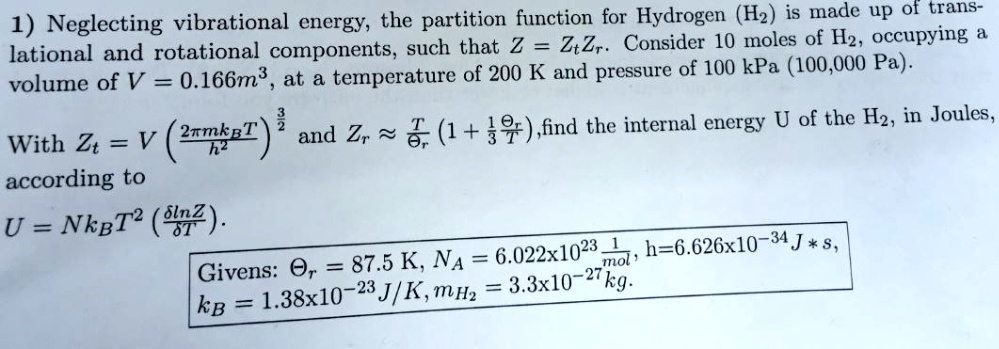
1) Neglecting vibrational energy, the partition function for Hydrogen (H2) is made up of translational and rotational components, such that $Z = Z_tZ_r$. Consider 10 moles of H2, occupying a volume of $V = 0.166m^3$, at a temperature of 200 K and pressure of 100 kPa (100,000 Pa).
With $Z_t = V \left(\frac{2\pi mk_BT}{h^2}\right)^{\frac{3}{2}}$ and $Z_r \approx \frac{T}{\Theta_r}\left(1 + \frac{1}{3}\frac{\Theta_r}{T}\right)$, find the internal energy U of the H2, in Joules, according to
$U = Nk_BT^2 \left(\frac{\delta lnZ}{\delta T}\right)$.
Givens: $\Theta_r = 87.5$ K, $N_A = 6.022x10^{23}\frac{1}{mol}$, $h = 6.626x10^{-34}$ J*s, $k_B = 1.38x10^{-23} J/K$, $m_{H_2} = 3.3x10^{-27} kg.$