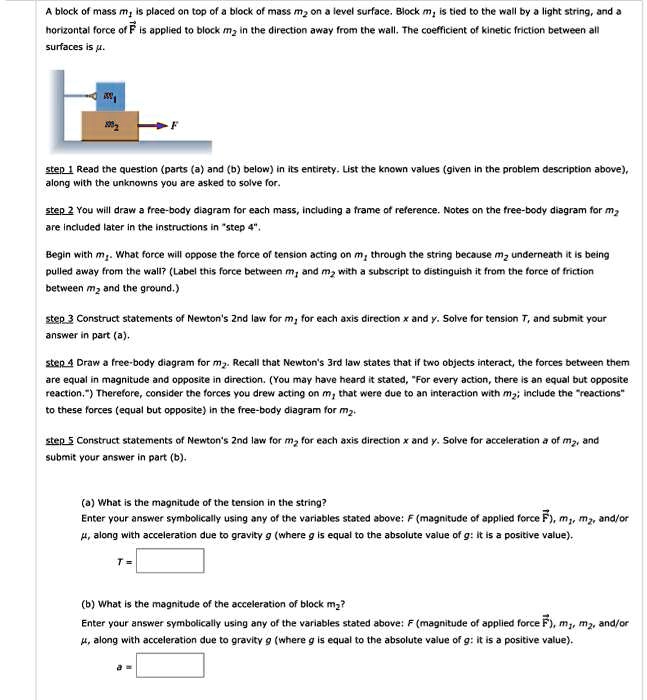
Texts: A block of mass m is placed on top of a block of mass m on a level surface. Block m is tied to the wall by a light string, and a horizontal force of F is applied to block m in the direction away from the wall. The coefficient of kinetic friction between all surfaces is u.
Along with the unknowns you are asked to solve for, begin with m. What force will oppose the force of tension acting on m through the string because m underneath it is being pulled away from the wall? Label this force between m and m with a subscript to distinguish it from the force of friction between m and the ground.
Step 3: Construct statements of Newton's 2nd law for m for each axis direction x and y. Solve for tension T, and submit your answer in part (a).
Step 4: Draw a free-body diagram for m. Recall that Newton's 3rd law states that if two objects interact, the forces between them are equal in magnitude and opposite in direction. (You may have heard it stated, "For every action, there is an equal but opposite reaction.") Therefore, consider the forces you drew acting on m that were due to an interaction with m; include the reactions" to these forces (equal but opposite) in the free-body diagram for m.
Step 5: Construct statements of Newton's 2nd law for m for each axis direction x and y. Solve for acceleration a of m and submit your answer in part (b).
(a) What is the magnitude of the tension in the string? Enter your answer symbolically using any of the variables stated above: F (magnitude of applied force F), m, and/or acceleration due to gravity g, where g is equal to the absolute value of g (it is a positive value).
(b) What is the magnitude of the acceleration of block m? Enter your answer symbolically using any of the variables stated above: F (magnitude of applied force F), m, and/or acceleration due to gravity g, where g is equal to the absolute value of g (it is a positive value).