i(t) = I<sub>s</sub> + A₁e<sup>s₁t</sup> + A₂e<sup>s₂t</sup> (Overdamped)
i(t) = I<sub>s</sub> + (A₁ + A₂t)e<sup>-at</sup> (Critically damped)
i(t) = I<sub>s</sub> + (A₁ cos ω<sub>d</sub>t + A₂ sin ω<sub>d</sub>t)e<sup>-at</sup> (Underdamped)
(8.49)
The constants A₁ and A₂ in each case can be determined from the initial conditions for i and di/dt. Again, we should keep in mind that Eq. (8.49) only applies for finding the inductor current i. But once the inductor current i<sub>L</sub> = i is known, we can find v = L di/dt, which is the same voltage across inductor, capacitor, and resistor. Hence, the current through the resistor is i<sub>R</sub> = v/R, while the capacitor current is i<sub>C</sub> = C dv/dt. Alternatively, the complete response for any variable x(t) may be found directly, using
x(t) = x<sub>ss</sub>(t) + x<sub>t</sub>(t)
(8.50)
where x<sub>ss</sub> and x<sub>t</sub> are its final value and transient response, respectively.
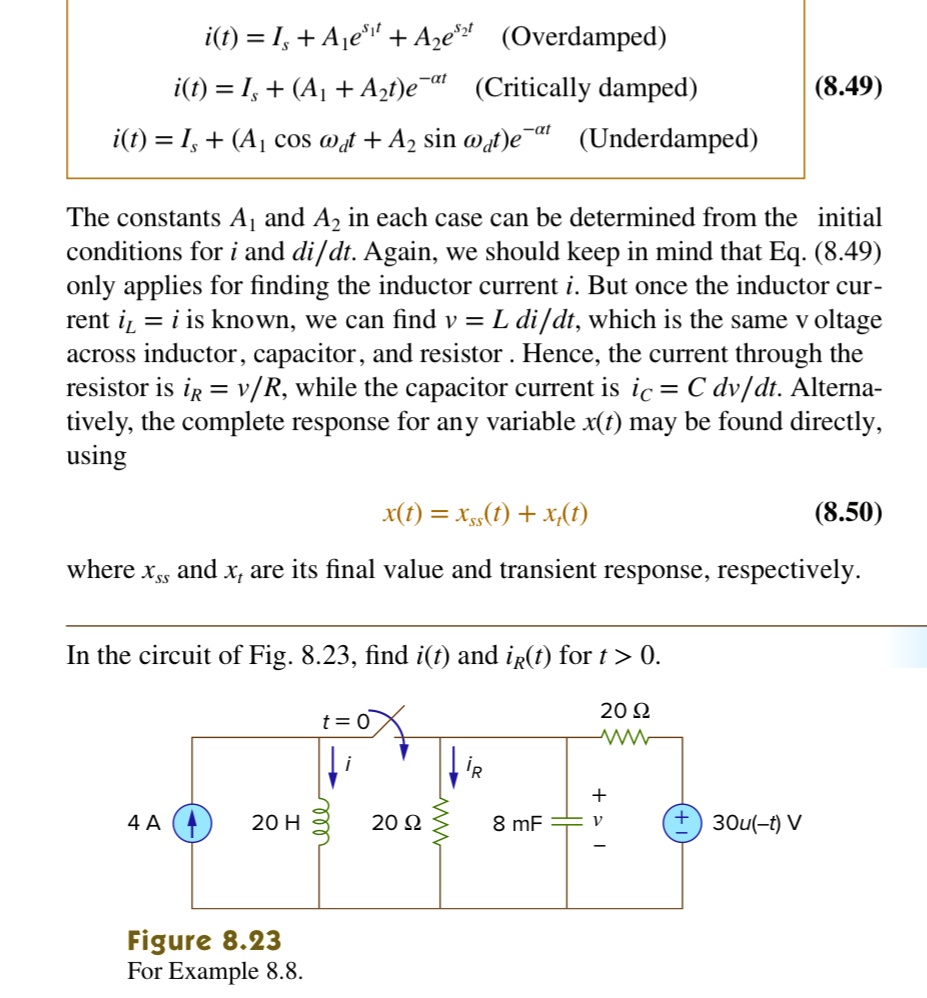
In the circuit of Fig. 8.23, find i(t) and i<sub>R</sub>(t) for t > 0.