3 The Bait and Switch
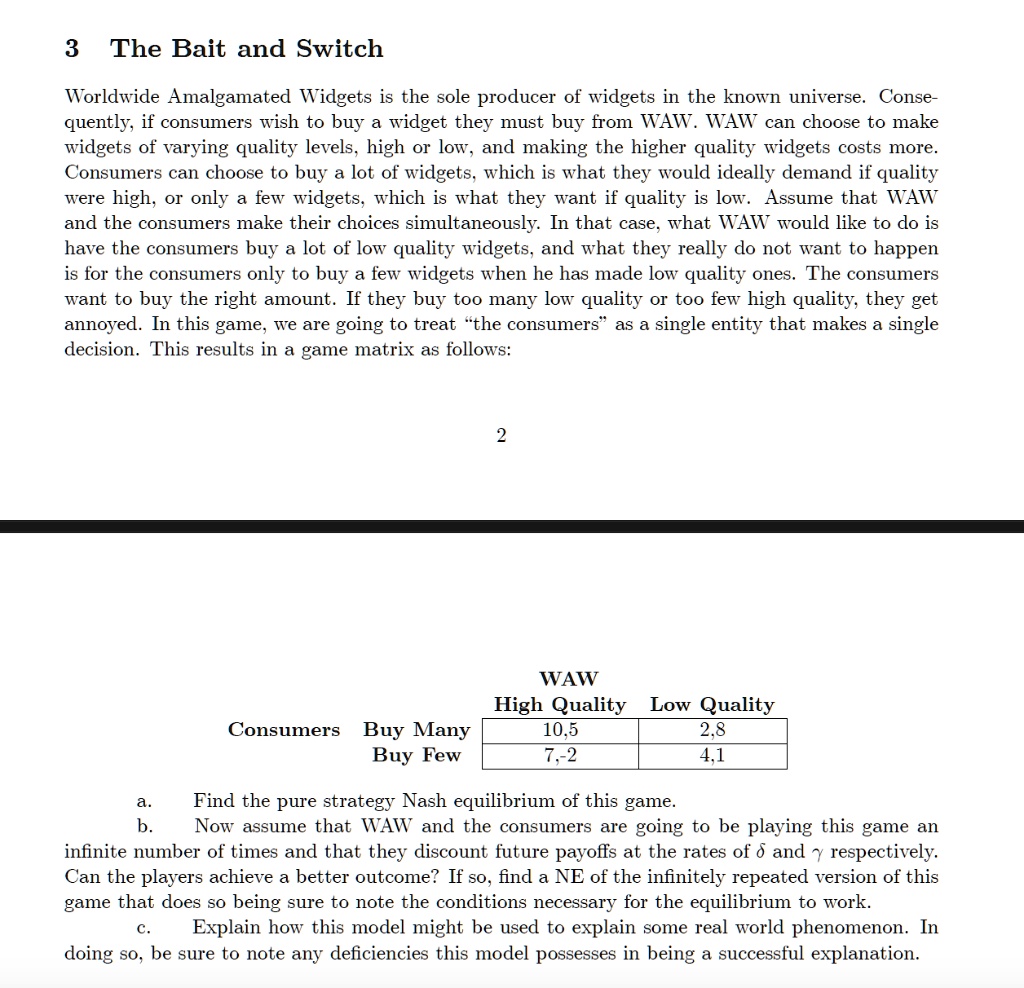
Worldwide Amalgamated Widgets is the sole producer of widgets in the known universe. Consequently, if consumers wish to buy a widget, they must buy from WAW. WAW can choose to make widgets of varying quality levels, high or low, and making the higher quality widgets costs more. Consumers can choose to buy a lot of widgets, which is what they would ideally demand if quality were high, or only a few widgets, which is what they want if quality is low. Assume that WAW and the consumers make their choices simultaneously. In that case, what WAW would like to do is have the consumers buy a lot of low-quality widgets, and what they really do not want to happen is for the consumers only to buy a few widgets when he has made low-quality ones. The consumers want to buy the right amount. If they buy too many low-quality or too few high-quality, they get annoyed. In this game, we are going to treat "the consumers" as a single entity that makes a single decision. This results in a game matrix as follows:
2
WAW
High Quality Low Quality Consumers Buy Many 10,5 2,8 Buy Few 7,-2 4,1
a. b.
Find the pure strategy Nash equilibrium of this game. Now assume that WAW and the consumers are going to be playing this game an infinite number of times and that they discount future payoffs at the rates of & and respectively. Can the players achieve a better outcome? If so, find a NE of the infinitely repeated version of this game that does so, being sure to note the conditions necessary for the equilibrium to work.
c. Explain how this model might be used to explain some real-world phenomena. In doing so, be sure to note any deficiencies this model possesses in being a successful explanation.