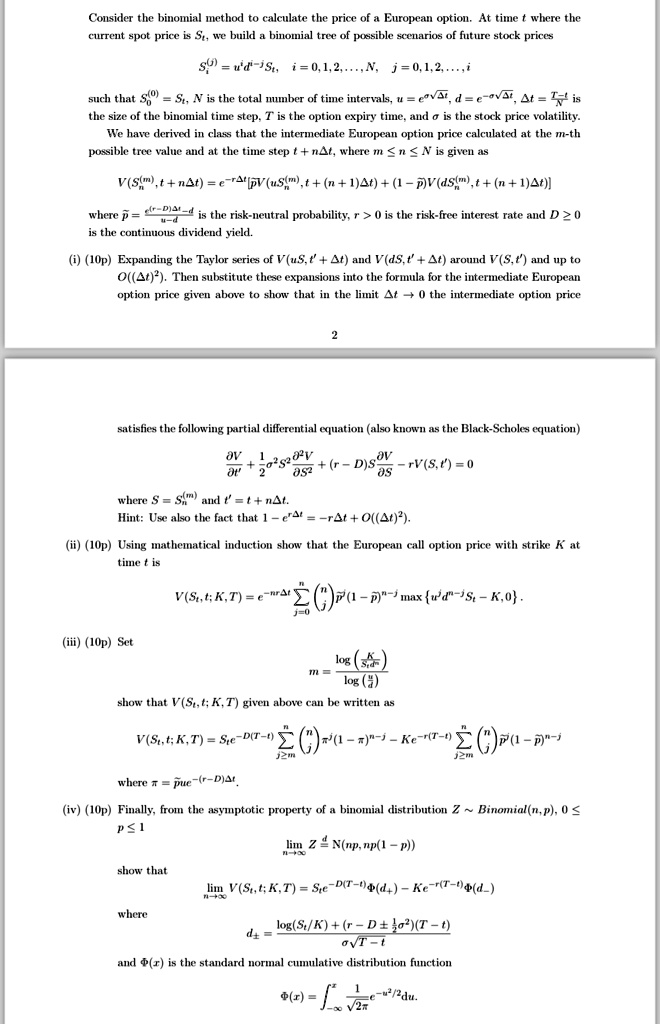
Consider the binomial method to calculate the price of a European option. At time t where the current spot price is S_(t), we build a binomial tree of possible scenarios of future stock prices S_(i)^((j))=u^(i)d^(i-j)S_(t), i=0,1,2,...,N, j=0,1,2,...,i such that S_(0)^((0))=S_(t), N is the total number of time intervals, u=e^(sigma sqrt(Delta t)), d=e^(-sigma sqrt(Delta t)), Delta t=(T-t)/(N) is the size of the binomial time step, T is the option expiry time, and sigma is the stock price volatility. We have derived in class that the intermediate European option price calculated at the m-th possible tree value and at the time step t+nDelta t, where m<=n<=N is given as V(S_(n)^((m)),t+nDelta t)=e^(-rDelta t)[(widetilde(p))V(uS_(n)^((m)),t+(n+1)Delta t)+(1-(widetilde(p)))V(dS_(n)^((m)),t+(n+1)Delta t)] where tilde(p)=(e^((r-D)Delta t)-d)/(u-d) is the risk-neutral probability, r>0 is the risk-free interest rate and D>=0 is the continuous dividend yield. (i) (10p) Expanding the Taylor series of V(uS,t^(')+Delta t) and V(dS,t^(')+Delta t) around V(S,t^(')) and up to O((Delta t)^(2)). Then substitute these expansions into the formula for the intermediate European option price given above to show that in the limit Delta t->0 the intermediate option price satisfies the following partial differential equation (also known as the Black-Scholes equation) (delV)/(delt^('))+(1)/(2)sigma ^(2)S^(2)(del^(2)V)/(delS^(2))+(r-D)S(delV)/(delS)-rV(S,t^('))=0 where S=S_(n)^((m)) and t^(')=t+nDelta t. Hint: Use also the fact that 1-e^(rDelta t)=-rDelta t+O((Delta t)^(2)). (ii) (10p) Using mathematical induction show that the European call option price with strike K at time t is V(S_(t),t;K,T)=e^(-nrDelta t)sum_(j=0)^n ([n],[j])tilde(p)^(j)(1-tilde(p))^(n-j)max{u^(j)d^(n-j)S_(t)-K,0}. (iii) (10p) Set m=(log((K)/(S_(t)d^(n))))/(log((u)/(d))) show that V(S_(t),t;K,T) given above can be written as V(S_(t),t;K,T)=S_(t)e^(-D(T-t))sum_(j>=m)^n ([n],[j])pi ^(j)(1-pi )^(n-j)-Ke^(-r(T-t))sum_(j>=m)^n ([n],[j])tilde(p)^(j)(1-tilde(p))^(n-j) where pi =tilde(p)ue^(-(r-D)Delta t). (iv) (10p) Finally, from the asymptotic property of a binomial distribution Z∼Binomial(n,p),0<= p<=1 lim_(n->infty )Z=^(d)N(np,np(1-p)) show that lim_(n->infty )V(S_(t),t;K,T)=S_(t)e^(-D(T-t))Phi (d_(+))-Ke^(-r(T-t))Phi (d_(-)) where d_(+-)=(log((S_(t))/(K))+(r-D+-(1)/(2)sigma ^(2))(T-t))/(sigma sqrt(T-t)) and Phi (x) is the standard normal cumulative distribution function Phi (x)=int_(-infty )^x (1)/(sqrt(2pi ))e^(-(u^(2))/(2))du.