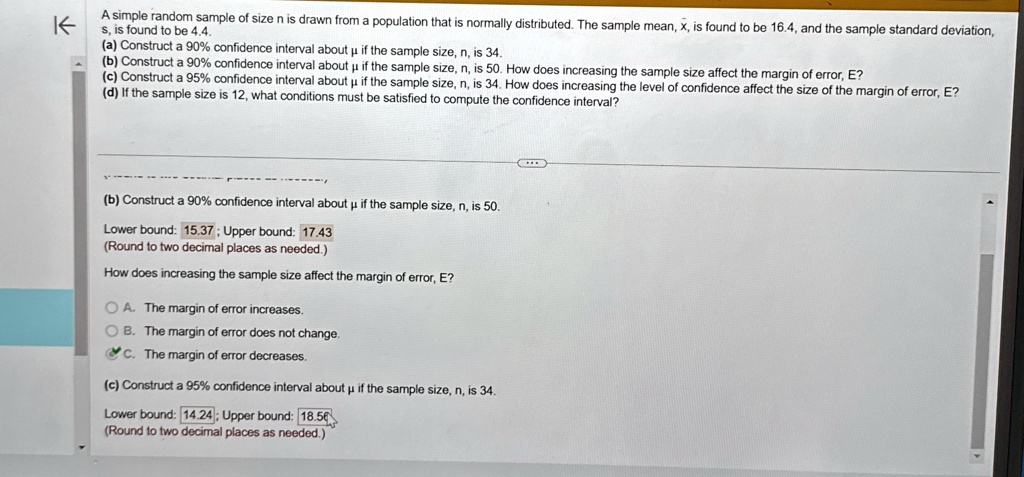
A simple random sample of size $n$ is drawn from a population that is normally distributed. The sample mean, $\bar{x}$, is found to be 16.4, and the sample standard deviation, $s$, is found to be 4.4.
(a) Construct a 90% confidence interval about $\mu$ if the sample size, $n$, is 34.
(b) Construct a 90% confidence interval about $\mu$ if the sample size, $n$, is 50. How does increasing the sample size affect the margin of error, $E$?
(c) Construct a 95% confidence interval about $\mu$ if the sample size, $n$, is 34. How does increasing the level of confidence affect the size of the margin of error, $E$?
(d) If the sample size is 12, what conditions must be satisfied to compute the confidence interval?
(b) Construct a 90% confidence interval about $\mu$ if the sample size, $n$, is 50.
Lower bound: 15.37; Upper bound: 17.43
(Round to two decimal places as needed.)
How does increasing the sample size affect the margin of error, $E$?
A. The margin of error increases.
B. The margin of error does not change.
C. The margin of error decreases.
(c) Construct a 95% confidence interval about $\mu$ if the sample size, $n$, is 34.
Lower bound: 14.24; Upper bound: 18.50
(Round to two decimal places as needed.)