Ace - AI Tutor
Ask Our Educators
Textbooks
My Library
Flashcards
Scribe - AI Notes
Notes & Exams
Download App
ANDY

ANDY

Divider

Viewed Questions

Rank in order, from highest to lowest, the temperatures $T_1=0 \mathrm{~K}, T_2=0^{\circ} \mathrm{C}$, and $T_3=0^{\circ} \mathrm{F}$.

Physics for Scientists and Engineers - A Strategic Approach

(II) A storage tank at STP contains 28.5 kg of nitrogen (N$_2$) ($a$) What is the volume of the tank? ($b$) What is the pressure if an additional 32.2 kg of nitrogen is added without changing the temperature?

(II) A storage tank at STP contains 28.5 kg of nitrogen (N$_2$) ($a$) What is the volume of the tank? ($b$) What is the pressure if an additional 32.2 kg of nitrogen is added without changing the temperature?

Physics: Principles with Applications

TEMPERATURE AND KINETIC THEORY

The Ideal Gas Law

(II) $(a)$ A brass plug is to be placed in a ring made of iron. At $15^{\circ} \mathrm{C}$ the diameter of the plug is 8.753 $\mathrm{cm}$ and that of the inside of the ring is 8.743 $\mathrm{cm} .$ They must both be brought to what common temperature in order to fit? (b) What if the plug were iron and the ring  brass?

(II) $(a)$ A brass plug is to be placed in a ring made of iron. At $15^{\circ} \mathrm{C}$ the diameter of the plug is 8.753 $\mathrm{cm}$ and that of the inside of the ring is 8.743 $\mathrm{cm} .$ They must both be brought to what common temperature in order to fit? (b) What if the plug were iron and the ring brass?

Physics for Scientists and Engineers with Modern Physics

(a) Determine the work done on a fluid that expands from i to $f$ as indicated in Figure $\mathrm{P} 20.24$ . (b) What If? How much work is performed on the fluid if it is compressed from $f$ to $i$ along the same path?

(a) Determine the work done on a fluid that expands from i to $f$ as indicated in Figure $\mathrm{P} 20.24$ . (b) What If? How much work is performed on the fluid if it is compressed from $f$ to $i$ along the same path?

Physics for Scientists and Engineers with Modern Physics

Questions asked

ANSWERED

Melissa Munoz verified

Numerade educator

To double the total energy of an oscillating mass-spring system, by what factor must the amplitude be increased? Select one: a. sqrt[4]{2} b. 4 c. sqrt{2} d. 2

View Answer
divider
ANSWERED

Vishal Gupta verified

Numerade educator

The figure shows a system of four particles connected by light rigid rods. Suppose a = b and M is slightly larger than m . About which of the coordinate axes does the system have the smallest moment of inertia? Select one: a. The y- axis . b. The moment of inertia is the same for all axes. c. The x- axis . d. The moment of inertia has the same value for two axes. e. The z axis.

View Answer
divider
ANSWERED

Eduard Sanchez verified

Numerade educator

At 20ºC an aluminum ring has a diameter of 20.00 cm, a bronze rod has an external diameter of 20.01 cm. If only the ring is heated to what temperature will the rod be able to enter the ring? Select one: a. 28.14°C b. 40.83°C c. 51.32°C d. 34.57°C

View Answer
divider
ANSWERED

Vincenzo Zaccaro verified

Numerade educator

1. Determine A formula for the nth sum of the partial series of the series and use it to determine whether the series converges or diverges, determine its sum (sum_{n=1}^{infty}left(frac{1}{n}-frac{1}{n+1} ight)) eleccione una: (s_{n}=1-frac{1}{2 n+1}) Divergent (s_{n}=1-frac{1}{2 n+1}) Divergent (s_{n}=1-frac{1}{n+1}) Convergent (s_{n}=1-frac{1}{n+1}) Divergent

View Answer
divider
ANSWERED

Vincenzo Zaccaro verified

Numerade educator

Select the series that converges to s = 4/5 and whose initial value is a = 1. Select one: a. sum from n = 0 to infinity of (-1)^n / 4^n b. sum from n = 1 to infinity of 1 / 4^(n-1) c. sum from n = 1 to infinity of 3 / 4^(n-1) d. sum from n = 2 to infinity of (-1)^(n-1) / 4^(n-1)

View Answer
divider
ANSWERED

Vincenzo Zaccaro verified

Numerade educator

Find the limit (if possible) of the sequence: { cos(nπ)} Select one: a. -1 b. 1 c. Diverge d. 0

View Answer
divider
ANSWERED

Jon Southam verified

Numerade educator

Determine the convergence of the sequence whose ( n )-th term is [ a_{n}=frac{ln (n+1)}{sqrt{n}} ] If the sequence is convergent, find its limit. Select one: converges to 1 It is divergent Converges to 0 Converges to -1

View Answer
divider
ANSWERED

Willis James verified

Numerade educator

After t weeks, it is expected that billions of pesos will be collected . How much would be collected if time were unlimited? (approximate your answer to three decimal places with a period separator (.) e.g. 15.036) f(t) = te^{3-t} Answer:

View Answer
divider
ANSWERED

Hoan Nguyen verified

Numerade educator

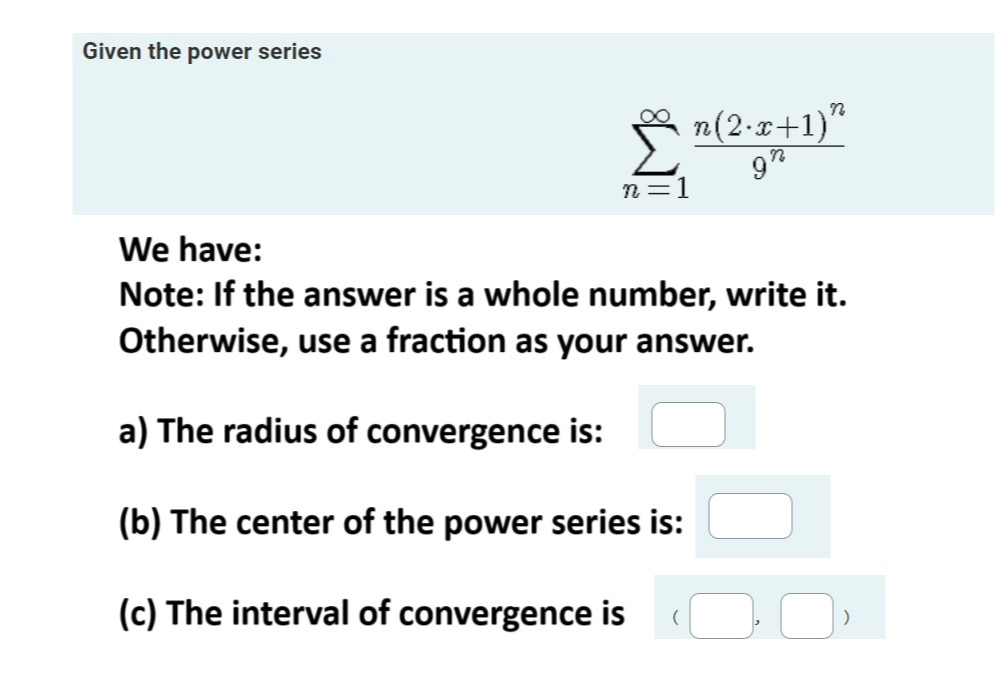
Given the power series [ sum_{n=1}^{infty} frac{n(2 cdot x+1)^{n}}{9^{n}} ] We have: Note: If the answer is a whole number, write it. Otherwise, use a fraction as your answer. a) The radius of convergence is: (b) The center of the power series is: (c) The interval of convergence is ( , )
View Answer
divider
ANSWERED

Hoan Nguyen verified

Numerade educator

Determine the convergence of the sequence whose nth term is?. If the sequence is convergent, find the limit. a_{n} = ((n + 1)/(n - 1)) ^ n

View Answer
divider