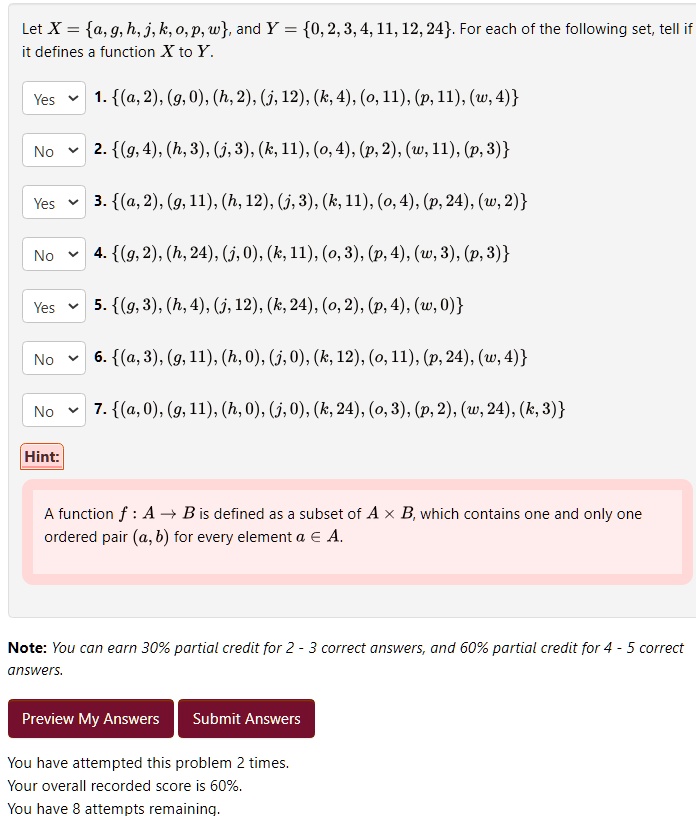
Let X = {a, g, h, j, k, o, p, w}, and Y = {0, 2, 3, 4, 11, 12, 24}. For each of the following set, tell if
it defines a function X to Y.
Yes
1. {(a, 2), (g, 0), (h, 2), (j, 12), (k, 4), (o, 11), (p, 11), (w, 4)}
No
2. {(g, 4), (h, 3), (j, 3), (k, 11), (o, 4), (p, 2), (w, 11), (p, 3)}
Yes
3. {(a, 2), (g, 11), (h, 12), (j, 3), (k, 11), (o, 4), (p, 24), (w, 2)}
No
Yes
4. {(g, 2), (h, 24), (j, 0), (k, 11), (o, 3), (p, 4), (w, 3), (p, 3)}
5. {(g, 3), (h, 4), (j, 12), (k, 24), (o, 2), (p, 4), (w, 0)}
No
No
6. {(a, 3), (g, 11), (h, 0), (j, 0), (k, 12), (o, 11), (p, 24), (w, 4)}
7. {(a, 0), (g, 11), (h, 0), (j, 0), (k, 24), (o, 3), (p, 2), (w, 24), (k, 3)}
Hint:
A function $f: A \to B$ is defined as a subset of $A \times B$, which contains one and only one
ordered pair $(a, b)$ for every element $a \in A$.
Note: You can earn 30% partial credit for 2 - 3 correct answers, and 60% partial credit for 4 - 5 correct
answers.
Preview My Answers Submit Answers
You have attempted this problem 2 times.
Your overall recorded score is 60%.
You have 8 attempts remaining.