Ace - AI Tutor
Ask Our Educators
Textbooks
My Library
Flashcards
Scribe - AI Notes
Notes & Exams
Download App
angela bruce

angela b.

Divider

Questions asked

BEST MATCH

Based on the concept of the looking glass self, a child will feel a sense of pride when praised by his or her parents. Question 31 options: True False

View Answer
divider
BEST MATCH

The duration of a perpetuity varies With interest rates directly inversely randomly

View Answer
divider
BEST MATCH

For the reaction described by the equation N2(g) + C2H2(g) ⇌ 2HCN(g), Kc = 10 at 300°C. Find the partial pressures of all gases in a 10-liter container at this temperature if the equilibrium mixture contains 10 mol of N2 and 100 mol of C2H2. [R = 0.0821 L∙atm/(mol*K)]

View Answer
divider
BEST MATCH

How do you determine theoretical & percent yield of ethyl acetate? Data: Mass of Flask: 92.25 g, Mass of Flask plus Ethyl acetate: 99.50 g. Ethyl Acetate Density (0.90 g/ml).

View Answer
divider
BEST MATCH

12 2 SO$_2$(g) + O$_2$(g) \rightleftharpoons 2 SO$_3$(g). K$_c$ = 0.45 The chemical reaction begins with an initial amount of each reactant. After 3 hours, the following conditions were determined: [SO$_2$] = 0.1 M, [O$_2$] = 0.01 M, and [SO$_3$] = 0.1 M Which direction does the reaction favor to establish equilibrium? A. both B. left C. right

View Answer
divider
BEST MATCH

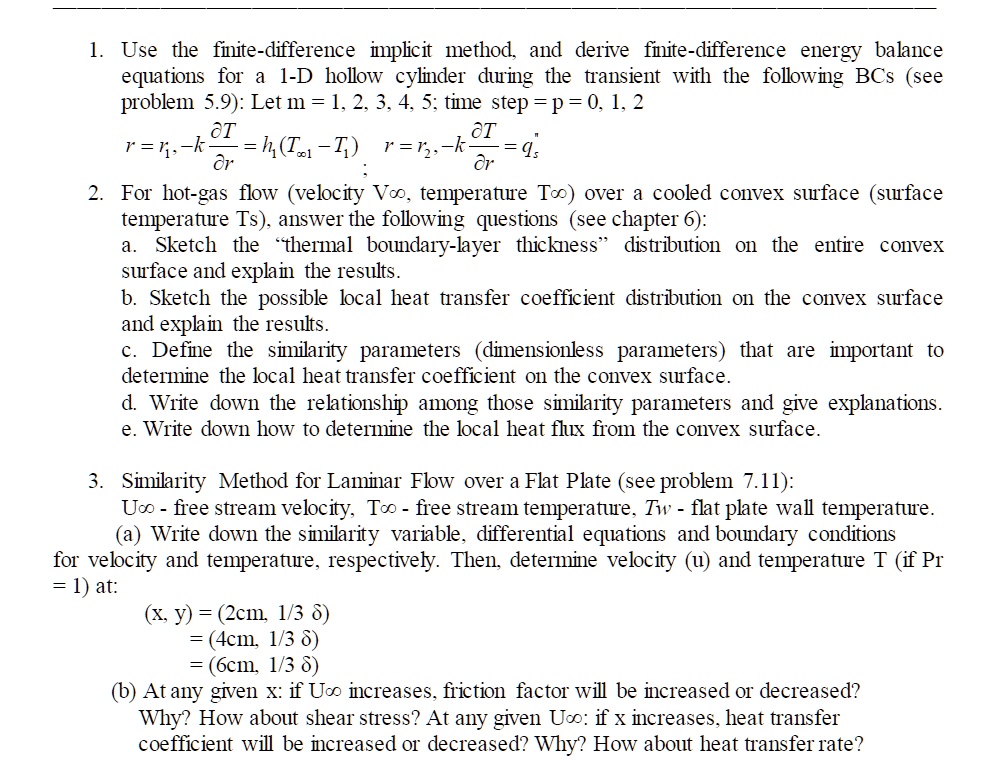
1. Use the finite-difference implicit method and derive finite-difference energy balance equations for a 1-D hollow cylinder during the transient with the following BCs (see problem 5.9): Let m = 1, 2, 3, 4, 5; time step = p = 0, 1, 2 = hT1 r=r 2. For hot-gas flow (velocity Vo, temperature To) over a cooled convex surface (surface temperature Ts), answer the following questions (see chapter 6): a. Sketch the thermal boundary-layer thickness distribution on the entire convex surface and explain the results. b. Sketch the possible local heat transfer coefficient distribution on the convex surface and explain the results. c. Define the similarity parameters (dimensionless parameters) that are important to determine the local heat transfer coefficient on the convex surface. d. Write down the relationship among those similarity parameters and give explanations. e. Write down how to determine the local heat flux from the convex surface. 3. Similarity Method for Laminar Flow over a Flat Plate (see problem 7.11): U.o - free stream velocity, Tco - free stream temperature, Tw - flat plate wall temperature. (a) Write down the similarity variable, differential equations, and boundary conditions for velocity and temperature, respectively. Then, determine velocity (u) and temperature T (if Pr = 1) at: (x, y) = (2cm, 1/3 8) = (4cm, 1/3 8) = (6cm, 1/3 8) (b) At any given x: if Uo increases, the friction factor will be increased or decreased? Why? How about shear stress? At any given Uoo: if x increases, the heat transfer coefficient will be increased or decreased? Why? How about the heat transfer rate?
View Answer
divider
BEST MATCH

Problem 4 (20 points) Compute $V_o$ for $i = 1 A$

View Answer
divider
BEST MATCH

A drug has a volume of distribution of 300 liters. What can we infer from this observation? A. The drug is confined largely in the plasma. B. The drug is subject to extensive first-pass metabolism. C. The drug is distributed mainly in body tissues. D. None of the above.

View Answer
divider
BEST MATCH

Assume that the Fed has decided to increase reserves in the banking system by $200 billion. Also assume that reserve requirements are 10% of deposits and assume that banks do not hold excess reserves. Answer the following questions. a. What happens to the Fed's balance sheet? b. What happens to the balance sheet of the banking system? c. What are some factors that may make the increase in reserves cause a smaller increase in the money supply?

View Answer
divider
BEST MATCH

In this exercise, you will be manipulating data in a one-dimensional array. All the work for this step will be done in the public static void main(String[] args) method. This is how to declare an array of primitives: int[] myNums = new int[10]; // This creates an array of 10 ints and all the values are initialized to zero. Create a class named ArrayWork. In this class, create the public static void main(String[] args) method. Create and initialize an array of ten ints. Change the values from zero to other values. (You can use random numbers using the Random class or type in values) a) Print the contents of the array. b) Print the contents of the array in reverse order. c) Print every other element of the array. d) Remove the 5th element of the array, moving all the other elements after the 5th element down one slot. Assign a value of 0 to the last slot in the array. Print the contents of the array once you have done this. Example: original contents: 3 5 6 2 7 8 1 13 12 15 remove 7: new contents: 3 5 6 2 8 1 13 12 15 0 e) Remove the 3rd element of the array, shifting all the elements after the 3rd element down one slot. Fill in the last slot with a 0. Print the contents of the array once you have done this. Example: original contents: 3 5 6 2 8 1 13 12 15 0 remove 6: new contents: 3 5 2 8 1 13 12 15 0 0 f) Create a new array, twice the size of the original array. Copy the contents of your original array into this new expanded array. Print the new array to verify.

View Answer
divider