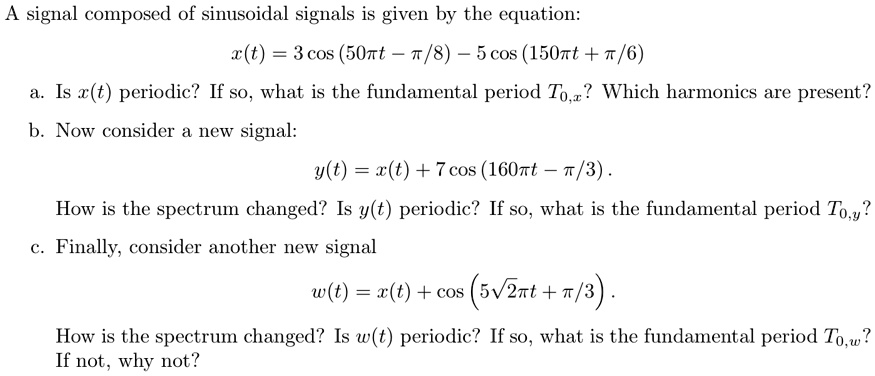
A signal composed of sinusoidal signals is given by the equation:
$x(t) = 3 \cos (50\pi t - \pi/8) - 5 \cos (150\pi t + \pi/6)$
a. Is $x(t)$ periodic? If so, what is the fundamental period $T_{0,x}$? Which harmonics are present?
b. Now consider a new signal:
$y(t) = x(t) + 7 \cos (160\pi t - \pi/3)$.
How is the spectrum changed? Is $y(t)$ periodic? If so, what is the fundamental period $T_{0,y}$?
c. Finally, consider another new signal
$w(t) = x(t) + \cos (5\sqrt{2}\pi t + \pi/3)$.
How is the spectrum changed? Is $w(t)$ periodic? If so, what is the fundamental period $T_{0,w}$?
If not, why not?