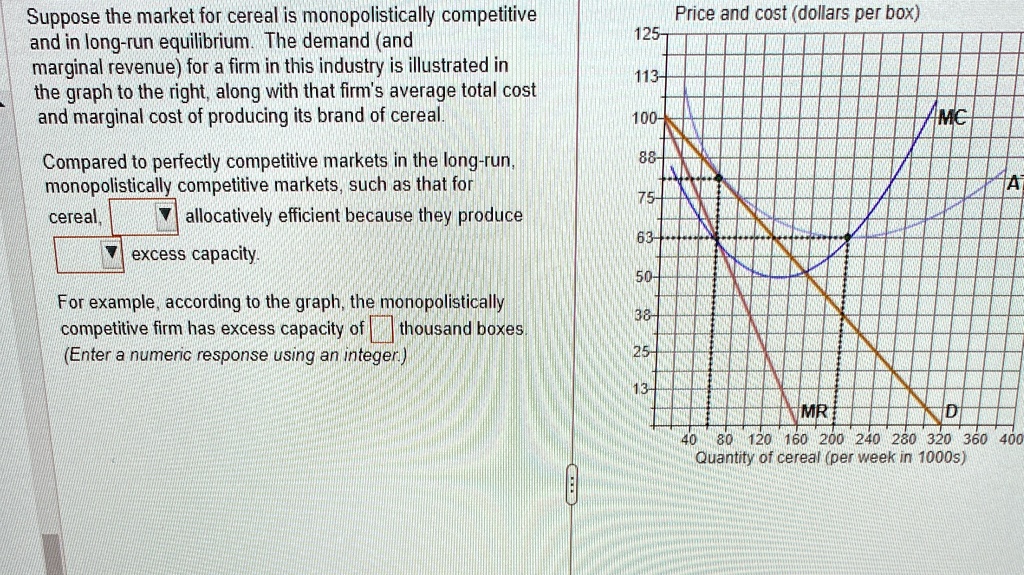
Suppose the market for cereal is monopolistically competitive
and in long-run equilibrium. The demand (and
marginal revenue) for a firm in this industry is illustrated in
the graph to the right, along with that firm's average total cost
and marginal cost of producing its brand of cereal.
Compared to perfectly competitive markets in the long-run,
monopolistically competitive markets, such as that for
cereal, \allocatively efficient because they produce
\excess capacity.
For example, according to the graph, the monopolistically
competitive firm has excess capacity of \ thousand boxes
(Enter a numeric response using an integer.)