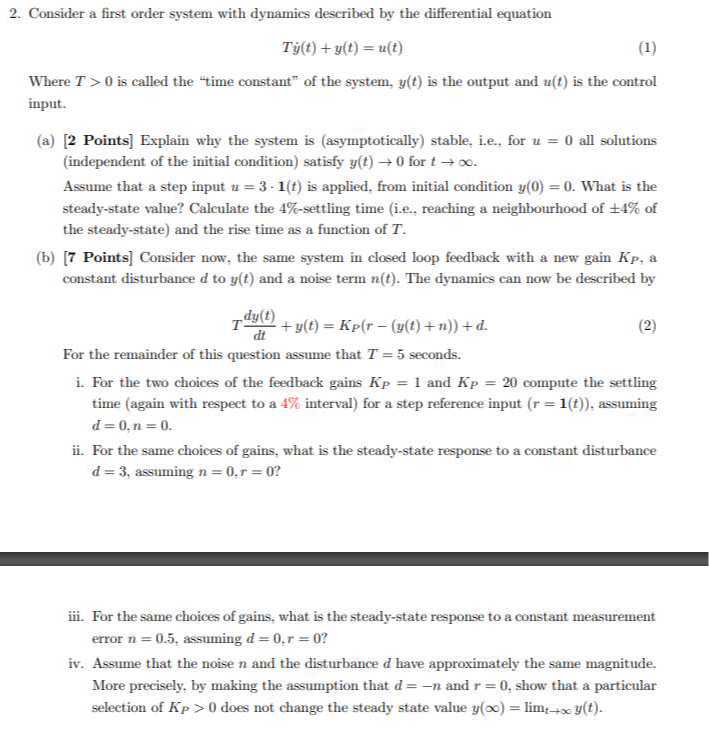
2. Consider a first order system with dynamics described by the differential equation
\[
T \dot{y}(t)+y(t)=u(t)
\]
Where \( T>0 \) is called the "time constant" of the system, \( y(t) \) is the output and \( u(t) \) is the control input.
(a) [2 Points] Explain why the system is (asymptotically) stable, i.e., for \( u=0 \) all solutions (independent of the initial condition) satisfy \( y(t) \rightarrow 0 \) for \( t \rightarrow \infty \).
Assume that a step input \( u=3 \cdot \mathbf{1}(t) \) is applied, from initial condition \( y(0)=0 \). What is the steady-state value? Calculate the \( 4 \% \)-settling time (i.e., reaching a neighbourhood of \( \pm 4 \% \) of the steady-state) and the rise time as a function of \( T \).
(b) [7 Points] Consider now, the same system in closed loop feedback with a new gain \( K_{P} \), a constant disturbance \( d \) to \( y(t) \) and a noise term \( n(t) \). The dynamics can now be described by
\[
T \frac{d y(t)}{d t}+y(t)=K_{P}(r-(y(t)+n))+d
\]
For the remainder of this question assume that \( T=5 \) seconds.
i. For the two choices of the feedback gains \( K_{P}=1 \) and \( K_{P}=20 \) compute the settling time (again with respect to a \( 4 \% \) interval) for a step reference input ( \( r=\mathbf{1}(t) \) ), assuming \( d=0, n=0 \).
ii. For the same choices of gains, what is the steady-state response to a constant disturbance \( d=3 \), assuming \( n=0, r=0 \) ?
iii. For the same choices of gains, what is the steady-state response to a constant measurement error \( n=0.5 \), assuming \( d=0, r=0 \) ?
iv. Assume that the noise \( n \) and the disturbance \( d \) have approximately the same magnitude. More precisely, by making the assumption that \( d=-n \) and \( r=0 \), show that a particular selection of \( K_{P}>0 \) does not change the steady state value \( y(\infty)=\lim _{t \rightarrow \infty} y(t) \).