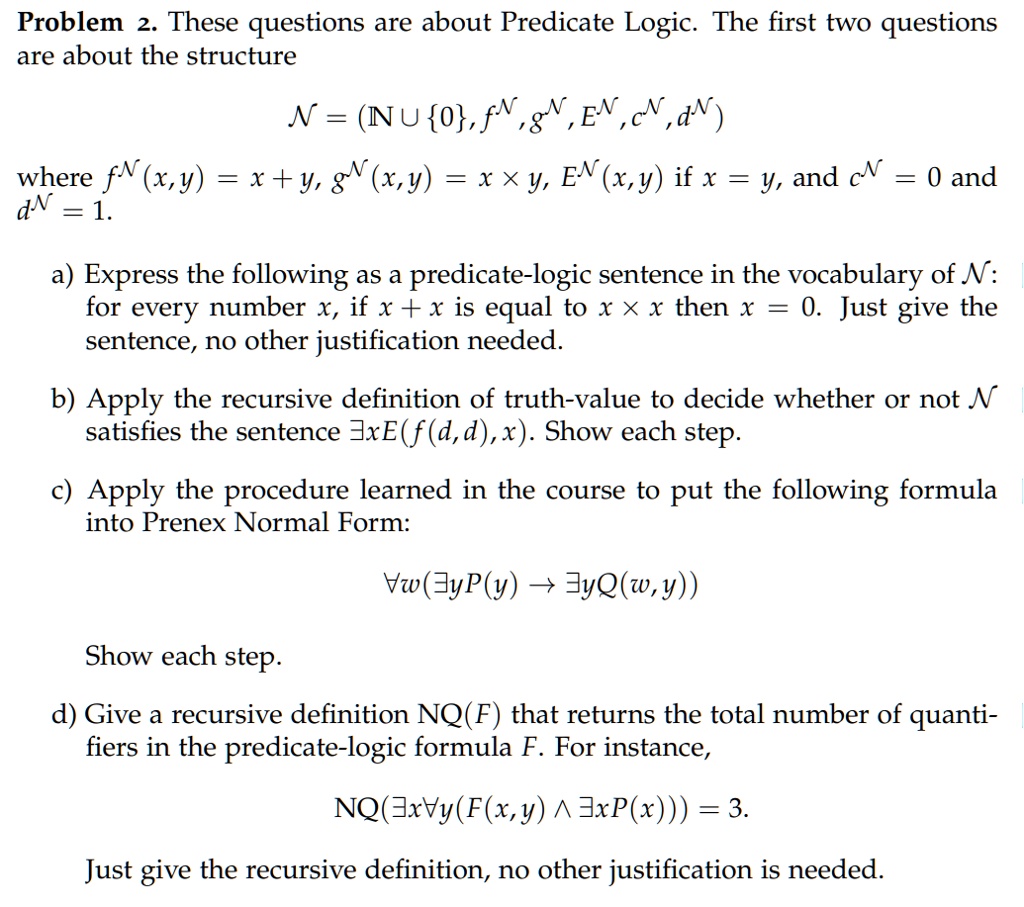
Problem 2. These questions are about Predicate Logic. The first two questions
are about the structure
N = (\mathbb{N} \cup \{0\}, f^N, g^N, E^N, c^N, d^N)
where $f^N(x, y) = x + y$, $g^N(x, y) = x \times y$, $E^N(x, y)$ if $x = y$, and $c^N = 0$ and
d^N = 1.
a) Express the following as a predicate-logic sentence in the vocabulary of N:
for every number x, if x + x is equal to x \times x then x = 0. Just give the
sentence, no other justification needed.
b) Apply the recursive definition of truth-value to decide whether or not N
satisfies the sentence $\exists x E(f(d, d), x)$. Show each step.
c) Apply the procedure learned in the course to put the following formula
into Prenex Normal Form:
$\forall w(\exists y P(y) \rightarrow \exists y Q(w, y))$
Show each step.
d) Give a recursive definition NQ(F) that returns the total number of quanti-
fiers in the predicate-logic formula F. For instance,
NQ($\exists x \forall y (F(x, y) \land \exists x P(x))$) = 3.
Just give the recursive definition, no other justification is needed.