meth
Which of the foregoing
charge-offs, (2) collection expenses, and (3) recoveries?
Your recommendations
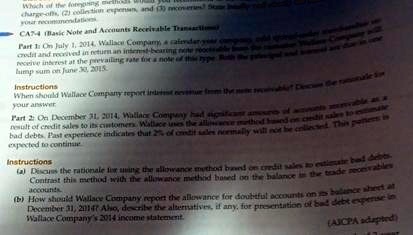
CA7-4 (Basic Note and Accounts Receivable Transactions)
Part 1: On July 1, 2014, Wallace Company, a calendar-year company, sold merchandise on account on
credit and received in return an interest-bearing note receivable. The principal and interest are due as a
receive interest at the prevailing rate for a note of this type. Both the principal and interest are due as a
lump sum on June 30, 2015.
Instructions
When should Wallace Company report interest revenue from the note receivable? Discuss the rationale for
your answer.
Part 2: On December 31, 2014, Wallace Company had significant accounts of accounts receivable as a
result of credit sales to its customers. Wallace uses the allowance method based on credit sales to estimate
bad debts. Past experience indicates that 2% of credit sales normally will not be collected. This pattern is
expected to continue.
Instructions
(a) Discuss the rationale for using the allowance method based on credit sales to estimate bad debts.
Contrast this method with the allowance method based on the balance in the trade receivables
accounts.
(b) How should Wallace Company report the allowance for doubtful accounts on its balance sheet at
December 31, 2014? Also, describe the alternatives, if any, for presentation of bad debt expense on
Wallace Company's 2014 income statement.
(AICPA adapted)