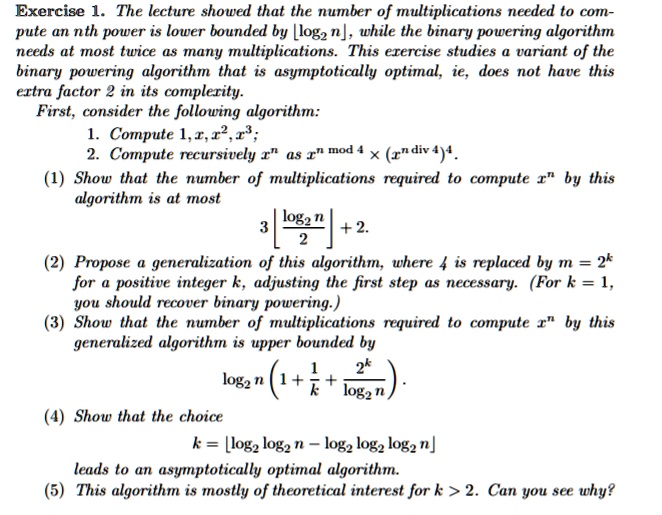
Exercise 1. The lecture showed that the number of multiplications needed to compute an nth power is lower bounded by [log?n], while the binary powering algorithm needs at most twice as many multiplications. This exercise studies a variant of the binary powering algorithm that is asymptotically optimal, i.e., does not have this extra factor 2 in its complexity.
First, consider the following algorithm:
1. Compute 1, x, x², x³;
2. Compute recursively x? as x? mod 4 × (x? div 4)?.
(1) Show that the number of multiplications required to compute x? by this algorithm is at most
$\left\lceil \frac{3}{2} \log_2 n \right\rceil + 2$.
(2) Propose a generalization of this algorithm, where 4 is replaced by m = 2? for a positive integer k, adjusting the first step as necessary. (For k = 1, you should recover binary powering.)
(3) Show that the number of multiplications required to compute x? by this generalized algorithm is upper bounded by
$\log_2 \left( 1 + \frac{1}{k} + \frac{2^k}{\log_2 n} \right)$.
(4) Show that the choice
$k = \left\lceil \log_2 \log_2 n - \log_2 \log_2 \log_2 n \right\rceil$
leads to an asymptotically optimal algorithm.
(5) This algorithm is mostly of theoretical interest for k > 2. Can you see why?