Ace - AI Tutor
Ask Our Educators
Textbooks
My Library
Flashcards
Scribe - AI Notes
Notes & Exams
Download App
angelica stout

angelica s.

Divider

Questions asked

BEST MATCH

Suppose a 4-member cartel faces a demand curve given by P = 88 -0.2Q. Each member of the cartel can produce at constant MC = $16. a) What quantity of the good should each cartel member produce to maximize total cartel profit? b) If one of the members of the cartel cheats and produces twice as much of the good as they were supposed to, how much does that increase their own individual profit? How does that affect the individual profit of each of the other members?

View Answer
divider
BEST MATCH

Huntington’s Disease results from a genetic error in which nervous system components degenerate with age. The disease does not show up until approximately age 50. It is a dominant phenotype, since one copy of the mutation is enough to cause pathology. Question Prompt Suppose that a woman with two children, aged 25 and 27, develops Huntington’s Disease at age 54 and is heterozygous. The father of the children does not have the disease. Questions Show each parent’s genotype. What are the chances that one of their children will develop Huntington’s Disease?

View Answer
divider
BEST MATCH

Which of the following processes occurs during transcription? proteins are synthesized mRNA attaches to ribosomes RNA is synthesized DNA is replicated 1 pts

View Answer
divider
BEST MATCH

You need to make your way to a family fishing trip. You must think about how you might get there, number of coolers you will bring, etc. $P(M = \text{train})$ 0.6 $P(N=0)$ $P(N = 1)$ 0.4 0.5 $M$ $M$ $N$ $N$ $P(T = \text{early}|M, N)$ $P(S = \text{fast}|N)$ $\text{train}$ 0 0.9 0 0.9 $\text{train}$ 1 0.85 1 0.8 $\text{train}$ 2 0.60 2 0.7 $\text{car}$ 0 0.75 $\text{car}$ 1 0.75 $\text{car}$ 2 0.75 $T$ $S$ $F$ $T$ $S$ $P(F = \text{yes}|T, S)$ $\text{early}$ $\text{fast}$ 0.95 $\text{early}$ $\text{slow}$ 0.7 $\text{late}$ $\text{fast}$ 0.7 $\text{late}$ $\text{slow}$ 0.35 $M \in \{\text{train, car}\}$ is how you will get to the fishing sight $N \in \{0, 1, 2\}$ is the number of coolers you will bring $T \in \{\text{early, late}\}$ is when you will get to the drop-off location $S \in \{\text{fast, slow}\}$ is how long it takes to sprint from the drop-off to the family gathering spot $F \in \{\text{yes, no}\}$ is whether you make it to the family fishing trip on time a) Compute $P(F = \text{yes} \mid N, M)$ for all $M$ and $N$. Show your work. b) How should you get to the family fishing trip, and how many coolers should you bring to maximize your chances of making the trip on time?

View Answer
divider
BEST MATCH

The Lorenz curve shows the percentage of Americans that earn below the poverty threshold. O True O False

View Answer
divider
BEST MATCH

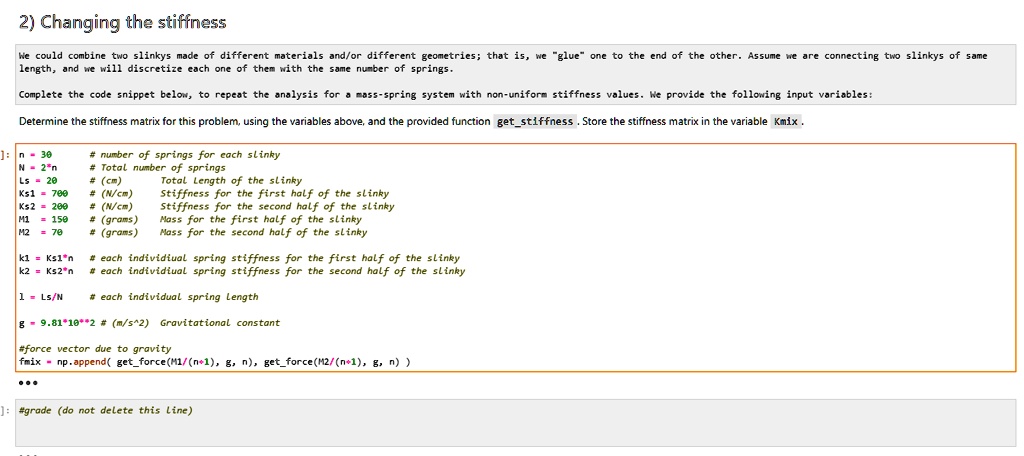
Changing the stiffness length, and we will discretize each one of them with the same number of springs. Determine the stiffness matrix for this problem, using the variables above, and the provided function get_stiffness. Store the stiffness matrix in the variable Kmix. n = 30, # number of springs for each slinky N = 2^(n), # Total number of springs Ls = 20, # (cm), Total Length of the slinky Ks1 = 700, # (N)/(C)m Stiffness for the first half of the slinky Ks2 = 200, # ((N)/(c)m), Stiffness for the second half of the slinky M1 = 150 # (grams) Mass for the first half of the slinky M2 = 70 # (grams) Mass for the second half of the slinky k1 = ks1^n, # each individual spring stiffness for the first half of the slinky k2 = ks2^n, # each individual spring stiffness for the second half of the slinky 1 = L(s)/(N), # each individual spring length g = 9.81*10^(2) # ((m)/(s^2)) Gravitational constant # force vector due to gravity fmix = np.append(force(M1/(n+1), g, n), get_force(M2/(n+1), g, n)) *** # grade (do not delete this line) 2) Changing the stiffness We could combine two slinkys made of different materials and/or different geometries; that is, we -glue one to the end of the other. Assume we are connecting two slinkys of the same length, and we will discretize each one of them with the same number of springs. Complete the code snippet below, to repeat the analysis for a mass-spring system with non-uniform stiffness values. We provide the following input variables Determine the stiffness matrix for this problem, using the variables above, and the provided function get_stiffness. Store the stiffness matrix in the variable Kmix. n = 30 N = 2*n Ls = 20 Ks1 = 760 Ks2 = 200 M1 = 159 M2 = 76 # number of springs for each slinky # cm) #(N/cm) #(N/cm) #(grams) #(grams) Total Length of the slinky Stiffness for the first half of the slinky Stiffness for the second half of the slinky Mass for the first half of the slinky Mass for the second half of the slinky k1 = Ks1*n # each individual spring stiffness for the first half of the slinky k2 = Ks2*n # each individual spring stiffness for the second half of the slinky 1 = Ls/N # each individual spring length g = 9.81*16^2 # (m/s^2) Gravitational constant # force vector due to gravity fmix = np.append(get_force(M1/n+1), g, n), get_force(M2/n+1), g, n)) ... ]: # grade (do not delete this line)
View Answer
divider
BEST MATCH

Find the exact value of each expression. (Enter your answer in radians.) (a) arctan(1)

View Answer
divider
BEST MATCH

Question 3 Match each term in the material balance equation with its definition. Input [Choose] Output Material the leaves the system by crossing its boundary Material that enters the system by crossing its boundary Generation Material is generated inside the system Net change in material inside the system Consumption Material that is consumed inside the system Accumulation [Choose] 1 pts

View Answer
divider
BEST MATCH

Title: C Program for Swapping Arrays #include <stdio.h> int main(void) { int A[20]; int len; scanf("%i", &len); for (int i = 0; i < len; i++) { scanf("%i", &A[i]); } // TODO: Swap array values for (int i = 0; i < len/2; i++) { int temp = A[i]; A[i] = A[len - i - 1]; A[len - i - 1] = temp; } // Print final array for (int i = 0; i < len; i++) { printf("%i ", A[i]); } return 0; }

View Answer
divider
BEST MATCH

Suppose a ball of mass M moving with velocity V strikes a motionless ball of mass m, which then acquires velocity v as a result of the collision. We assume the balls to be perfectly elastic and the collision perfectly central (head-on). Based on the the laws of conservation of energy and momentum, we can find that the velocity v is given by the formula \(v = \frac{2M}{m+M}V.\) From this we see that if 0 < m < M, then V? v? 2V. In other words, if a larger ball strikes a smaller motionless ball, the latter will acquire velocity at most 2V. How can a significant part of the kinetic energy of a larger mass be communicated to a body of small mass? To do this, for example, one can insert balls with intermediate masses between the balls of small and large mass: m <m? <m2 <...< m < M. Let us compute (after Huygens) how the masses m1, m2,..., mn should be chosen to that the body m will acquire maximum velocity after successive central collisions. (a) Start with one extra ball. Applying (*) twice, we see that in this case the acquired velocity is \(v = \frac{2m_1}{m+m_1}(\frac{2M}{m_1+M})V = \frac{2m_1}{m+m_1}\cdot\frac{m_1}{m_1+M}\cdot 2^2V.\) Find a critical point of v as a function m?. What can you say about the ratios \(\frac{m}{m_1}, \frac{m_1}{M}\) at that critical point? (b) Now consider the case of two extra balls, with masses m? and m2 (the big ball first strikes the mass m? and then m?). Write the formula for the acquired velocity u and find (the only) critical point of v as a function of m? and m2. What can you say about the ratios \(\frac{m}{m_1}, \frac{m_1}{m_2}, \frac{m_2}{M}\) at that critical point?

View Answer
divider