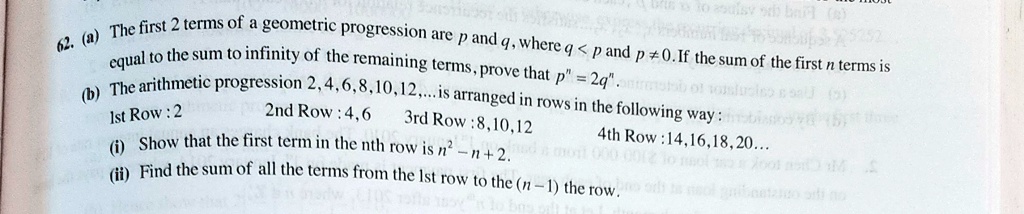
62. (a) The first 2 terms of a geometric progression are p and q, where q < p and p \neq 0. If the sum of the first n terms is equal to the sum to infinity of the remaining terms, prove that $p^n = 2q^n$.
(b) The arithmetic progression 2, 4, 6, 8, 10, 12,... is arranged in rows in the following way:
1st Row: 2
2nd Row: 4, 6
3rd Row: 8, 10, 12
4th Row: 14, 16, 18, 20...
(i) Show that the first term in the nth row is $n^2 - n + 2$.
(ii) Find the sum of all the terms from the 1st row to the (n - 1) the row.