CÂU 1.
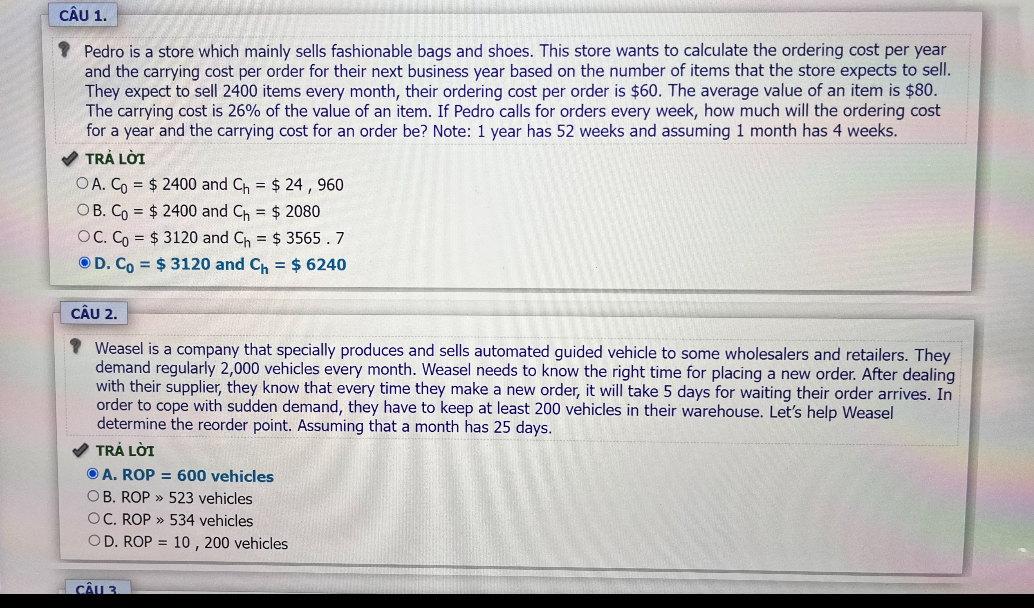
Pedro is a store which mainly sells fashionable bags and shoes. This store wants to calculate the ordering cost per year and the carrying cost per order for their next business year based on the number of items that the store expects to sell. They expect to sell 2400 items every month, their ordering cost per order is \( \$ 60 \). The average value of an item is \( \$ 80 \). The carrying cost is \( 26 \% \) of the value of an item. If Pedro calls for orders every week, how much will the ordering cost for a year and the carrying cost for an order be? Note: 1 year has 52 weeks and assuming 1 month has 4 weeks.
TR? L?
A. \( C_{0}=\$ 2400 \) and \( C_{h}=\$ 24,960 \)
B. \( C_{0}=\$ 2400 \) and \( C_{h}=\$ 2080 \)
C. \( C_{0}=\$ 3120 \) and \( C_{h}=\$ 3565.7 \)
D. \( \mathrm{C}_{0}=\$ 3120 \) and \( \mathrm{C}_{\mathrm{h}}=\$ 6240 \)
CÂU 2 .
Weasel is a company that specially produces and sells automated guided vehicle to some wholesalers and retailers. They demand regularly 2,000 vehicles every month. Weasel needs to know the right time for placing a new order. After dealing with their supplier, they know that every time they make a new order, it will take 5 days for waiting their order arrives. In order to cope with sudden demand, they have to keep at least 200 vehicles in their warehouse. Let's help Weasel determine the reorder point. Assuming that a month has 25 days.
TRÁ LòI
A. ROP \( =600 \) vehicles
B. ROP 523 vehicles
C. ROP 534 vehicles
D. ROP \( =10,200 \) vehicles