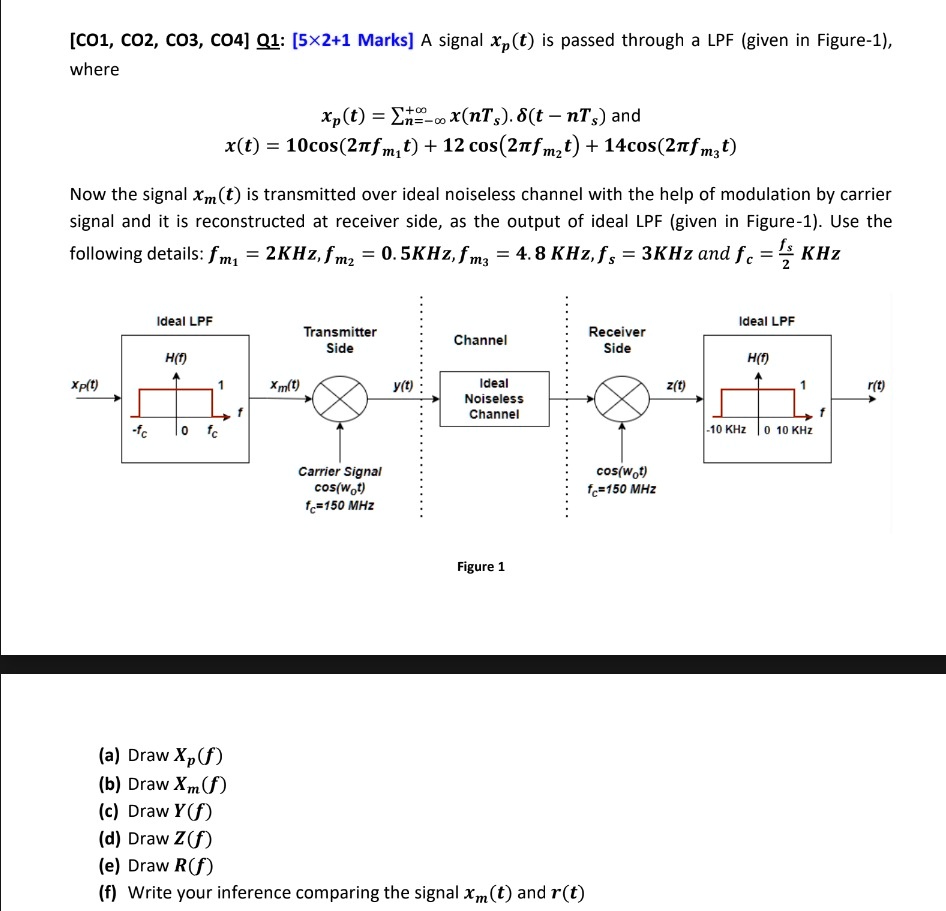
[CO1, CO2, CO3, CO4] Q1: [5×2+1 Marks] A signal $x_p(t)$ is passed through a LPF (given in Figure-1),
where
$x_p(t) = \sum_{n=-\infty}^{\infty} x(nTs) \cdot \delta(t - nTs)$ and
$x(t) = 10cos(2\pi f_{m1}t) + 12 cos(2\pi f_{m2}t) + 14cos(2\pi f_{m3}t)$
Now the signal $x_m(t)$ is transmitted over ideal noiseless channel with the help of modulation by carrier
signal and it is reconstructed at receiver side, as the output of ideal LPF (given in Figure-1). Use the
following details: $f_{m1} = 2KHz$, $f_{m2} = 0.5KHz$, $f_{m3} = 4.8 KHz$, $f_s = 3KHz$ and $f_c = \frac{f_s}{2} KHz$
(a) Draw $X_p(f)$
(b) Draw $X_m(f)$
(c) Draw $Y(f)$
(d) Draw $Z(f)$
(e) Draw $R(f)$
(f) Write your inference comparing the signal $x_m(t)$ and $r(t)$