Z
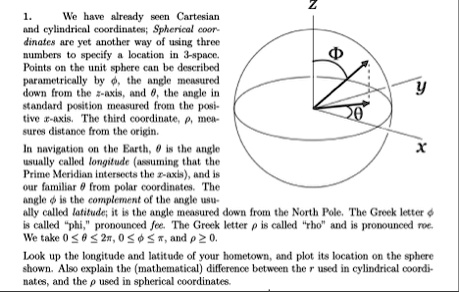
1. We have already seen Cartesian and cylindrical coordinates; Spherical coordinates are yet another way of using three numbers to specify a location in 3-space. Points on the unit sphere can be described parametrically by $\phi$, the angle measured down from the z-axis, and $\theta$, the angle in standard position measured from the positive x-axis. The third coordinate, $\rho$, measures distance from the origin.
In navigation on the Earth, $\theta$ is the angle usually called longitude (assuming that the Prime Meridian intersects the z-axis), and is our familiar $\theta$ from polar coordinates. The angle $\phi$ is the complement of the angle usually called latitude; it is the angle measured down from the North Pole. The Greek letter $\phi$ is called "phi," pronounced fee. The Greek letter $\rho$ is called "rho" and is pronounced roe. We take $0 \le \theta \le 2\pi$, $0 \le \phi \le \pi$, and $\rho \ge 0$.
Look up the longitude and latitude of your hometown, and plot its location on the sphere shown. Also explain the (mathematical) difference between the $r$ used in cylindrical coordinates, and the $\rho$ used in spherical coordinates.