Recall:
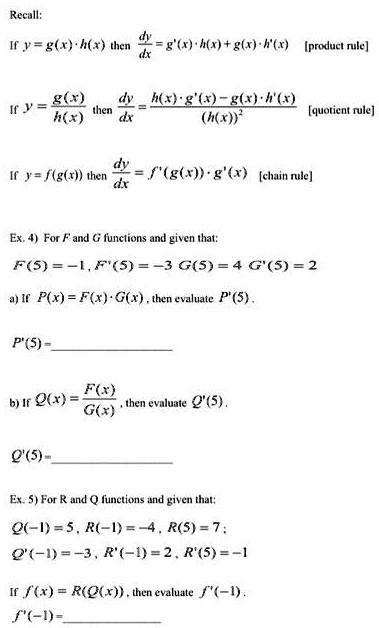
If $y = g(x) \cdot h(x)$ then $\frac{dy}{dx} = g'(x) \cdot h(x) + g(x) \cdot h'(x)$ [product rule]
$\frac{g(x)}{h(x)}$
If $y = \frac{g(x)}{h(x)}$ then $\frac{dy}{dx} = \frac{h(x) \cdot g'(x) - g(x) \cdot h'(x)}{(h(x))^2}$ [quotient rule]
If $y = f(g(x))$ then $\frac{dy}{dx} = f'(g(x)) \cdot g'(x)$ [chain rule]
Ex. 4) For F and G functions and given that:
F(5) = -1, F'(5) = -3 G(5) = 4 G'(5) = 2
a) If P(x) = F(x) \cdot G(x), then evaluate P'(5).
P'(5) = _____
$\frac{F(x)}{G(x)}$
b) If Q(x) = $\frac{F(x)}{G(x)}$, then evaluate Q'(5).
Q'(5) = _____
Ex. 5) For R and Q functions and given that:
Q(-1) = 5, R(-1) = -4, R(5) = 7;
Q'(-1) = -3, R'(-1) = 2, R'(5) = -1
If f(x) = R(Q(x)), then evaluate f'(-1).
f'(-1) = _____