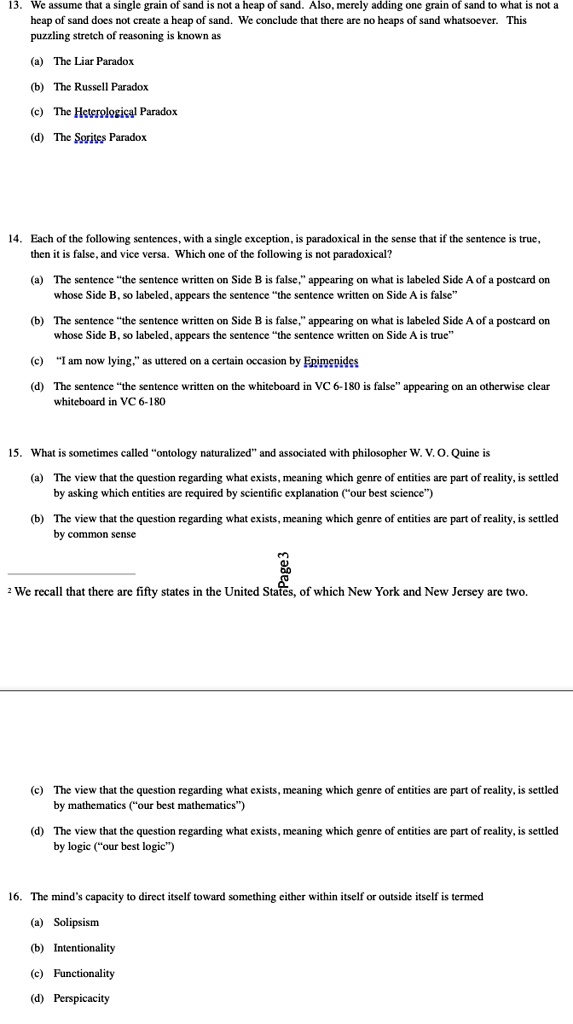
A heap of sand does not create a heap of sand. We conclude that there are no heaps of sand whatsoever. This puzzling stretch of reasoning is known as:
(b) The Russell Paradox
(c) The Heterological Paradox
(d) The Sorites Paradox
14. Each of the following sentences, with a single exception, is paradoxical in the sense that if the sentence is true, then it is false, and vice versa. Which one of the following is not paradoxical?
(a) The sentence written on Side B is false, appearing on what is labeled Side A of a postcard on whose Side B, so labeled, appears the sentence the sentence written on Side A is false
(b) The sentence written on Side B is false, appearing on what is labeled Side A of a postcard on whose Side B, so labeled, appears the sentence the sentence written on Side A is true
(c) I am now lying, as uttered on a certain occasion by Epimenides
(d) The sentence written on the whiteboard in VC 6-180 is false appearing on an otherwise clear whiteboard in VC 6-180
15. What is sometimes called ontology naturalized and associated with philosopher W. V. O. Quine is:
(a) The view that the question regarding what exists, meaning which genre of entities are part of reality, is settled by asking which entities are required by scientific explanation (our best science)
(b) The view that the question regarding what exists, meaning which genre of entities are part of reality, is settled by common sense. We recall that there are fifty states in the United States, of which New York and New Jersey are two.
(c) The view that the question regarding what exists, meaning which genre of entities are part of reality, is settled by mathematics (our best mathematics)
(d) The view that the question regarding what exists, meaning which genre of entities are part of reality, is settled by logic (our best logic)
16. The mind's capacity to direct itself toward something either within itself or outside itself is termed:
(a) Solipsism
(b) Intentionality
(c) Functionality
(d) Perspicacity