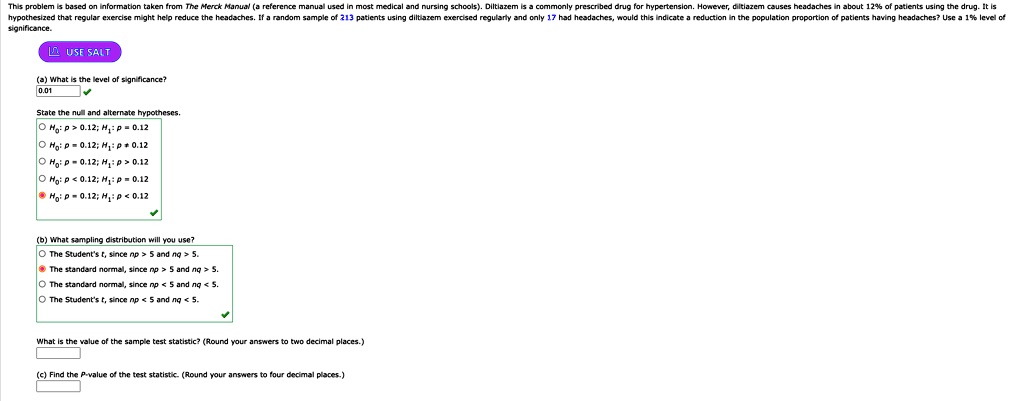
This problem is based on information taken from The Merck Manual (a reference manual used in most medical and nursing schools). Diltiazem is a commonly prescribed drug for hypertension. However, diltiazem causes headaches in about 12% of patients using the drug. It is
hypothesized that regular exercise might help reduce the headaches. If a random sample of 213 patients using diltiazem exercised regularly and only 17 had headaches, would this indicate a reduction in the population proportion of patients having headaches? Use a 1% level of
significance.
USE SALT
(a) What is the level of significance?
0.01
State the null and alternate hypotheses.
$H_0: p > 0.12; H_1: p = 0.12$
$H_0: p = 0.12; H_1: p \ne 0.12$
$H_0: p = 0.12; H_1: p > 0.12$
$H_0: p < 0.12; H_1: p = 0.12$
$H_0: p = 0.12; H_1: p < 0.12$
(b) What sampling distribution will you use?
The Student's t, since np > 5 and nq > 5.
The standard normal, since np > 5 and nq > 5.
The standard normal, since np < 5 and nq < 5.
The Student's t, since np < 5 and nq < 5.
What is the value of the sample test statistic? (Round your answers to two decimal places.)
(c) Find the P-value of the test statistic. (Round your answers to four decimal places.)