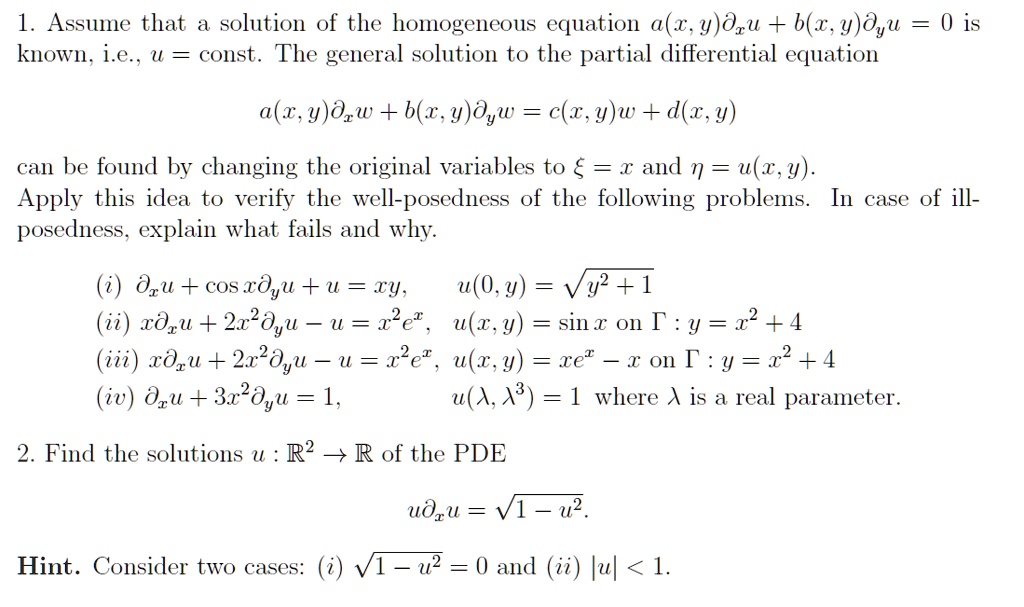
1. Assume that a solution of the homogeneous equation $a(x, y)\partial_x u + b(x, y)\partial_y u = 0$ is known, i.e., $u = const$. The general solution to the partial differential equation
$a(x, y)\partial_x w + b(x, y)\partial_y w = c(x, y)w + d(x, y)$
can be found by changing the original variables to $\xi = x$ and $\eta = u(x, y)$.
Apply this idea to verify the well-posedness of the following problems. In case of ill-posedness, explain what fails and why.
(i) $\partial_x u + \cos x \partial_y u + u = xy$, $u(0, y) = \sqrt{y^2 + 1}$
(ii) $x\partial_x u + 2x^2 \partial_y u - u = x^2 e^x$, $u(x, y) = \sin x$ on $\Gamma: y = x^2 + 4$
(iii) $x\partial_x u + 2x^2 \partial_y u - u = x^2 e^x$, $u(x, y) = xe^x - x$ on $\Gamma: y = x^2 + 4$
(iv) $\partial_x u + 3x^2 \partial_y u = 1$, $u(\lambda, \lambda^3) = 1$ where $\lambda$ is a real parameter.
2. Find the solutions $u: \mathbb{R}^2 \to \mathbb{R}$ of the PDE
$u\partial_x u = \sqrt{1 - u^2}$.
Hint. Consider two cases: (i) $\sqrt{1 - u^2} = 0$ and (ii) $|u| < 1$.