Ace - AI Tutor
Ask Our Educators
Textbooks
My Library
Flashcards
Scribe - AI Notes
Notes & Exams
Download App
anne garner

anne g.

Divider

Questions asked

BEST MATCH

Calculate the energy charge of the cell assuming that the concentration of ATP, ADP, and AMP were all equal. Why is this value not a good representation of actual energy charge in a healthy cell?

View Answer
divider
BEST MATCH

Find the value of $\iiint_E xy \, dV$, where $E$ is the solid shown $y = x$ $z = 4 - y^2$

View Answer
divider
BEST MATCH

1.22 In which of the following cases is the map \( \varphi: P \rightarrow Q \) orderpreserving? (i) \( P=Q=(\mathbb{Z} ; \leqslant) \), and \( \varphi(x)=x+1 \). (ii) \( P=(\wp(S) ; \subseteq) \) with \( |S|>1, Q=2 \), and \( \varphi(U)=1 \) if \( U \neq \varnothing \) and \( \varphi(\varnothing)=0 \). (iii) \( P=(\wp(S) ; \subseteq) \) with \( |S|>1, Q=2 \), and \( \varphi(U)=1 \) if \( U=S \) and \( \varphi(U)=0 \) if \( U \neq S \). (iv) \( P=Q=\left(\mathbb{N}_{0} ; \preccurlyeq\right) \), and \( \varphi(x)=n x \) (with \( n \in \mathbb{N}_{0} \) fixed). (v) \( P=(\wp(S) ; \subseteq), Q=2 \), and \( \varphi(U)=1 \) if \( x \in U \) and \( \varphi(U)=0 \) otherwise (with \( x \in S \) fixed). (vi) \( P=Q=(\wp(\mathbb{N}) ; \subseteq) \), and \( \varphi \) defined by \[ \varphi(U)=\left\{\begin{array}{ll} \{1\} & \text { if } 1 \in U \\ \{2\} & \text { if } 2 \in U \text { and } 1 \notin U \\ \varnothing & \text { otherwise } \end{array}\right. \]

View Answer
divider
BEST MATCH

2.tWhat type of computer is likely to use SO-DIMMs, have an internal power supply, and use a desktop processor socket?

View Answer
divider
BEST MATCH

Which of the following choices contains the best pairing of the scientific method steps with the process of solving the everyday problem

View Answer
divider
BEST MATCH

Contingent liabilities should be recorded with a journal entry and appear directly in the financial statements when the likelihood is remote and a reasonable estimate of the amount can be made the likelihood is probable and a reasonable estimate of the amount can be made the likelihood is reasonably possible and a reasonable estimate of the amount can be made the likelihood is probable and a reasonable estimate of the amount cannot be made

View Answer
divider
BEST MATCH

4) How many milliliters of 0.260 M Na$_2$S are needed to react with 45.00 mL of 0.315 M AgNO$_3$? Na$_2$S(aq) + 2 AgNO$_3$(aq) $\rightarrow$ 2 NaNO$_3$(aq) + Ag$_2$S(s) A) 54.5 mL B) 27.3 mL C) 74.3 mL D) 109 mL

View Answer
divider
BEST MATCH

There are two uniform slender bars OA and BC as shown. Bar A has a mass of 6 kg. Bar B has a mass of 8 kg. The bars are welded at A to form a T-shaped member and are rotating freely about a horizontal axis through O. The bars have an angular velocity = -4 rad/s as OA passes the horizontal position shown. The angular acceleration C is unknown. The mass moment of inertia of the composite body A-B is Io = 2.625 N-s^2-m. What is the reaction force Fo? 0.25m 0.5m X A 0.25m B

View Answer
divider
BEST MATCH

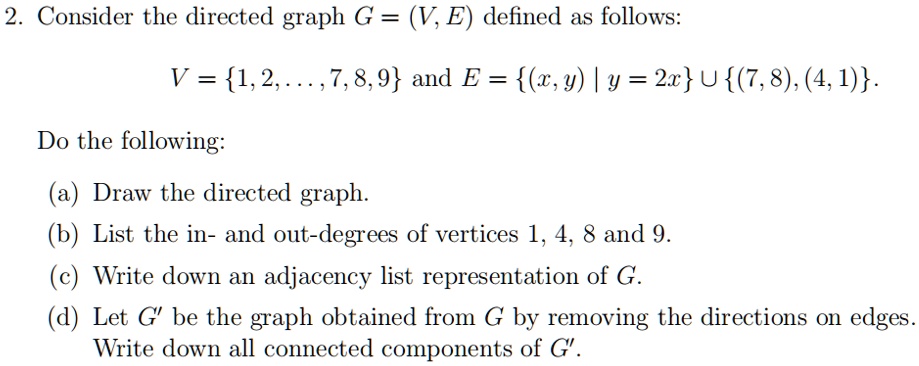
2. Consider the directed graph G = (V, E) defined as follows: V = {1, 2, ..., 7, 8, 9} and E = {(x, y) | y = 2x} \cup {(7, 8), (4, 1)}. Do the following: (a) Draw the directed graph. (b) List the in- and out-degrees of vertices 1, 4, 8 and 9. (c) Write down an adjacency list representation of G. (d) Let G' be the graph obtained from G by removing the directions on edges. Write down all connected components of G'.
View Answer
divider
BEST MATCH

1.1 Practice with propagation of errors 1. You measure a set of data for a pendulum and plotted the period vs. the square root of the length, because according to the small angle approximation, $T = 2\pi\sqrt{L/g}$. The slope of your fit ($y = Bx$) is $B = (2.1\pm0.1) s/m^{1/2}$. Does your experiment agree with the accepted value of $g = 9.80 m/s^2$? (Note: do this by propagating the error from B to g.) 2. The weighted average of two quantities $x_1$ and $x_2$ is $\bar{x} = \frac{w_1x_1 + w_2x_2}{w_1 + w_2}$, where $w_j = \delta x_j^{-2}$, and the uncertainty in $\bar{x}$ is given by $\delta\bar{x} = \sqrt{\frac{\delta x_1^2\delta x_2^2}{\delta x_1^2 + \delta x_2^2}}$ (You do not need to derive this.) (a) Show mathematically that this quantity is smaller than $\delta x_1$. (Hint: Figure out how to write the expression above as $\delta\bar{x} = \frac{\delta x_1}{\sqrt{1 + (\delta x_1/\delta x_2)^2}}$, then carefully argue that this is smaller than $\delta x_1$.) (b) In a similar fashion, it's also possible to show that $\delta\bar{x} < \delta x_2$. (You don't need to.) Briefly explain why it makes sense that $\delta\bar{x}$ is smaller than both $\delta x_1$ and $\delta x_2$. (Hint: this is related to the idea of the standard deviation of the mean.)

View Answer
divider