Ace - AI Tutor
Ask Our Educators
Textbooks
My Library
Flashcards
Scribe - AI Notes
Notes & Exams
Download App
anthony cruz

anthony c.

Divider

Questions asked

BEST MATCH

A higher end car company also operates a low-cost subsidiary to combat low-cost rivals. This is an example of what strategy? a) Fighter brand b) Dumping c) Collusion d) Stealth attack

View Answer
divider
BEST MATCH

Comedy tends to use stereotypes more than types. exalt the worth of individuals. satirize the manners of society. place the characters in difficult, irresolvable situations.

View Answer
divider
BEST MATCH

A reboiler is a heat exchanger used to generate the vapor supplied to the top tray of a distillation column. O True O False

View Answer
divider
BEST MATCH

Provide the missing numbers in the following data. Enter only the digits - no dollar signs, commas, decimal points, plus signs, or pennies. Use a minus sign if the change is negative. Beginning of the period: Assets = Liabilities = 289181 Equity = 361476 Change in the period: Assets = -120000 Liabilities = -110000 Equity = -10000 End of the period: Assets = Liabilities = 179181 Equity = 351476

View Answer
divider
BEST MATCH

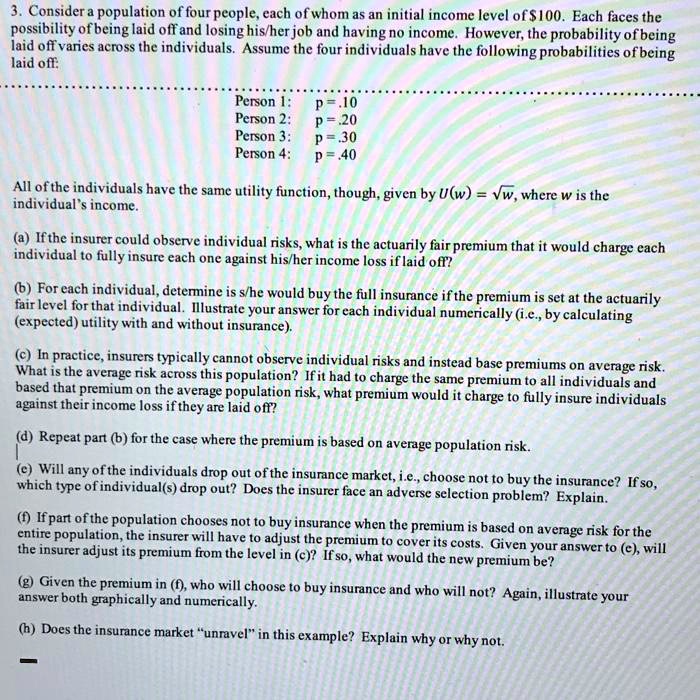
Consider a population of four people, each of whom has an initial income level of $100. Each faces the possibility of being laid off and losing his/her job and having no income. However, the probability of being laid off varies across the individuals. Assume the four individuals have the following probabilities of being laid off: Person 1: p = 0.10 Person 2: p = 0.20 Person 3: p = 0.30 Person 4: p = 0.40 All of the individuals have the same utility function, though, given by U(w) = Vw, where w is the individual's income. a) If the insurer could observe individual risks, what is the actuarially fair premium that it would charge each individual to fully insure each one against his/her income loss if laid off? b) For each individual, determine if he/she would buy the full insurance if the premium is set at the actuarially fair level for that individual. Illustrate your answer for each individual numerically, i.e., by calculating (expected) utility with and without insurance. c) In practice, insurers typically cannot observe individual risks and instead base premiums on average risk. What is the average risk across this population? If it had to charge the same premium to all individuals and based that premium on the average population risk, what premium would it charge to fully insure individuals against their income loss if they are laid off? d) Repeat part (b) for the case where the premium is based on average population risk. Will any of the individuals drop out of the insurance market, i.e., choose not to buy the insurance? If so, which type of individual(s) drop out? Does the insurer face an adverse selection problem? Explain. f) If part of the population chooses not to buy insurance when the premium is based on average risk, will the insurer adjust its premium from the level in (c)? If so, what would the new premium be? g) Given the premium in (f), who will choose to buy insurance and who will not? Again, illustrate your answer both graphically and numerically. h) Does the insurance market "unravel" in this example? Explain why or why not.
View Answer
divider
BEST MATCH

The principal represents an amount of money deposited in a savings account subject to compound interest at the given rate. Principal Rate Compounded Time $11,000 6% semiannually 4 years A. Find how much money there will be in the account after the given number of years. B. Find the interest earned. Click the icon to view some finance formulas. A. The amount of money in the account after 4 years is $ (Round to the nearest hundredth as needed.) B. The amount of interest earned is $ (Round to the nearest hundredth as needed.)

View Answer
divider
BEST MATCH

When a company uses the perpetual inventory method, which of the following would be the entry to adjust inventory to lower-of-cost-or- market? A. debit Loss on Inventory and credit Merchandise Inventory B. debit Inventory Adjustment and credit Merchandise Inventory C. debit Merchandise Inventory and credit Inventory Adjustment D. debit Merchandise Inventory and credit Cost of Goods Sold E. none of the above.

View Answer
divider
BEST MATCH

3. (20 points) Consider the following RLC circuit. R represents resistance, L represents inductance, and C represents capacitance. In particular, C stands for capacitance, and C stands for the unit Coulombs. Assume the following initial conditions for q(t): q0=0. The natural angular frequency ωo of the system is the angular frequency of the solutions to the unforced equation. Find ωo.

View Answer
divider
BEST MATCH

a) A thermo gate consists of a 6061-T6-aluminum plate ($\alpha = 24 \times 10^{-6} / \text{C}$, E = 68.9 GPa) from A-B and a Am-1004-T61-magnesium plate ($\alpha = 26 \times 10^{-6} / \text{C}$, E = 44.7 GPa) from C-D. Each have a width of 15 mm and are fixed at their ends. If the gap between them is 1.5 mm when the temperature is $T_1 = 25^\circ \text{C}$, determine the temperature required to just close the gap. b) What is the axial force in each plate if the temperature becomes $T_2 = 100^\circ \text{C}$?

View Answer
divider
BEST MATCH

1- (a) The edges OP, OQ and OR of a tetrahedron OPQR are vectors p, q and r, respectively, where p = 2i+4j, q = 2i-j+3k and r = 4i-2j+5k. Show that OP is perpendicular to the plane containing OQR. Express the volume of the tetrahedron in terms of p, q and r and hence calculate the volume. (b) Referring to the figure below (i) determine the angle \(\theta\) between the diagonal AD of the cube and the edge AB and also (ii) find the angle between the diagonal AD of the cube and the diagonal AC.

View Answer
divider