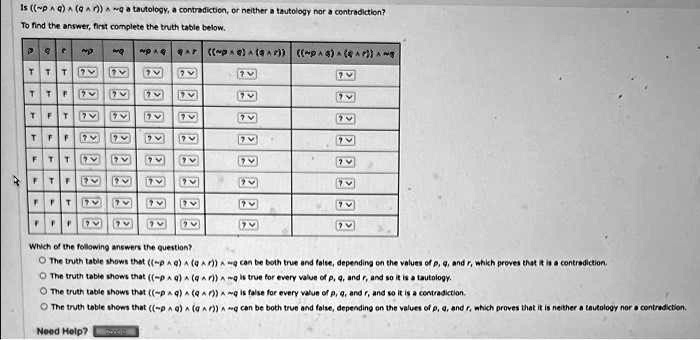
Is $((p \rightarrow q) \land (q \rightarrow r)) \rightarrow \neg q$ a tautology, a contradiction, or neither a tautology nor a contradiction?
To find the answer, first complete the truth table below.
Which of the following answers the question?
The truth table shows that $((p \rightarrow q) \land (q \rightarrow r)) \rightarrow \neg q$ can be both true and false, depending on the values of p, q, and r, which proves that it is a contradiction.
The truth table shows that $((p \rightarrow q) \land (q \rightarrow r)) \rightarrow \neg q$ is true for every value of p, q, and r, and so it is a tautology.
The truth table shows that $((p \rightarrow q) \land (q \rightarrow r)) \rightarrow \neg q$ is false for every value of p, q, and r, and so it is a contradiction.
The truth table shows that $((p \rightarrow q) \land (q \rightarrow r)) \rightarrow \neg q$ can be both true and false, depending on the values of p, q, and r, which proves that it is neither a tautology nor a contradiction.