§7: (Section 1.7; related to Exercise 1.7.34) Recall the three elementary (row)
operations that are used for Gaussian Elimination:
(1) Add a multiple (say $m \in \mathbb{R}$) of one equation (say $j$) to another equation
(say $i > j$).
(2) Interchange two equations (say $i$ and $j$).
(3) Multiply an equation (say $i$) by a nonzero constant (say $m \in \mathbb{R}$).
Let $A \in \mathbb{R}^{n \times n}$ be given, and apply the first elementary operation. In other words,
we add $m$ times row $j$ to row $i$ to obtain a new matrix $\hat{A}$. Now perform the same
elementary operation again, but this time start with the $n \times n$ identity matrix $I$,
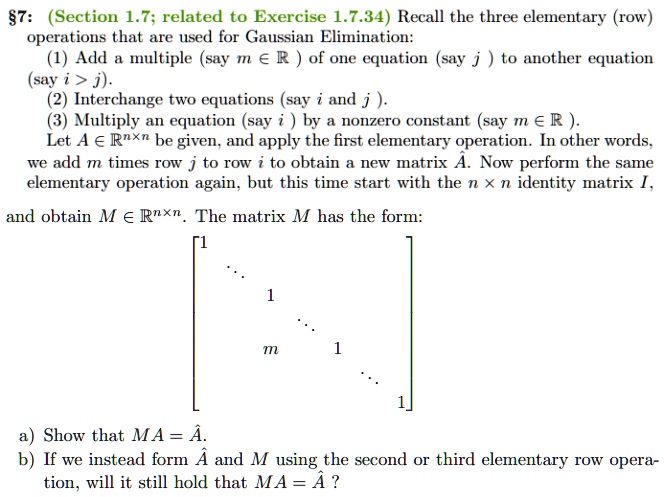
and obtain $M \in \mathbb{R}^{n \times n}$. The matrix $M$ has the form:
$$
\begin{bmatrix}
1 & & & & \\
& \ddots & & & \\
& & 1 & & \\
& m & & 1 & \\
& & & & \ddots & \\
& & & & & 1
\end{bmatrix}
$$
a) Show that $MA = \hat{A}$.
b) If we instead form $\hat{A}$ and $M$ using the second or third elementary row opera-
tion, will it still hold that $MA = \hat{A}$ ?