Part A
At its natural resting length, a muscle is close to its
optimal length for producing force. As the muscle
contracts, the maximum force it can deliver decreases.
When a muscle is at approximately 80% of its natural
length, it cannot contract much more and the force it
can produce drops drastically. For a muscle stretched
beyond its natural length, the same is true. At about
120% of its natural length, the force that a muscle can
exert again drops drastically.
This muscle length to force relationship can be
demonstrated by doing a chin-up. As you hang from
the bar, your biceps muscles are stretched and can
produce only a relatively small force. As you get close
to the bar, your biceps muscles contract substantially,
and you again experience difficulty. The easiest part of
the chin-up occurs somewhere in between, when your
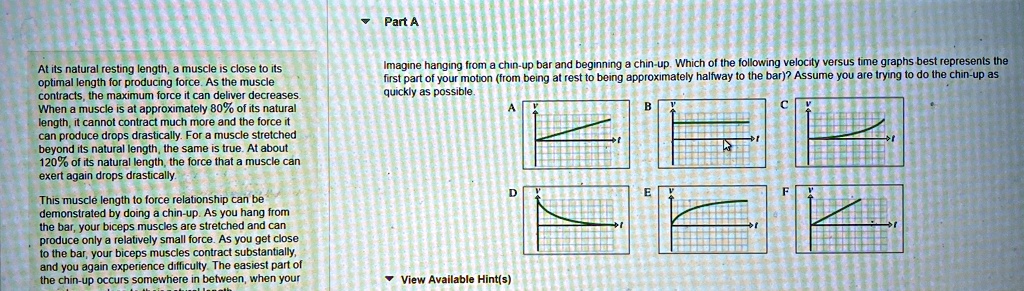
Imagine hanging from a chin-up bar and beginning a chin-up. Which of the following velocity versus time graphs best represents the
first part of your motion (from being at rest to being approximately halfway to the bar)? Assume you are trying to do the chin-up as
quickly as possible.
View Available Hint(s)