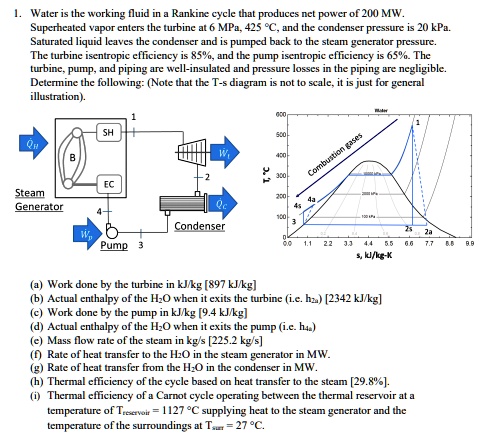
Water is the working fluid in a Rankine cycle that produces a net power of 200 MW. Superheated vapor enters the turbine at 6 MPa, 425°C, and the condenser pressure is 20 kPa. Saturated liquid leaves the condenser and is pumped back to the steam generator pressure. The turbine isentropic efficiency is 85%, and the pump isentropic efficiency is 65%. The turbine, pump, and piping are well-insulated, and pressure losses in the piping are negligible. Determine the following: (Note that the T-s diagram is not to scale, it is just for general illustration).
(a) Work done by the turbine in kJ/kg [897 kJ/kg]
(b) Actual enthalpy of the water when it exits the turbine (i.e. h3) [2342 kJ/kg]
(c) Work done by the pump in kJ/kg [9.4 kJ/kg]
(d) Actual enthalpy of the water when it exits the pump (i.e. h4)
(e) Mass flow rate of the steam in kg/s [225.2 kg/s]
(f) Rate of heat transfer to the water in the steam generator in MW
(g) Rate of heat transfer from the water in the condenser in MW
(h) Thermal efficiency of the cycle based on heat transfer to the steam [29.8%]
(i) Thermal efficiency of a Carnot cycle operating between the thermal reservoir at a temperature of Treservoir = 1127°C supplying heat to the steam generator and the temperature of the surroundings at Tsur = 27°C.