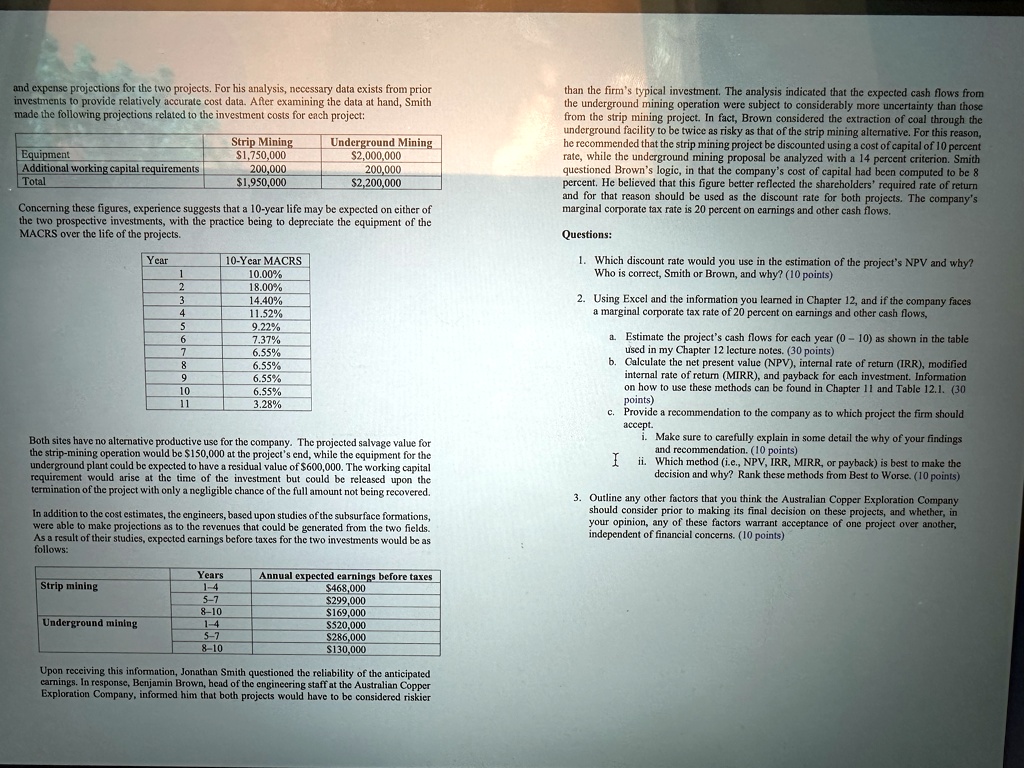
.On January 2, 2024, an Australian Copper Exploration Company was investigating the feasibility of two mutually exclusive investment projects. The first prospective investment involved a strip (open cut) mining operation in South Wales. The second investment also involved the extraction of copper, but this expenditure would be an underground site in Queensland. Preliminary drilling, sampling, and analysis of both sites and consultation with geologists, costing the company $3600,000, suggested that both sites have similar copper reserves and useful lives. The copper extraction process for the two types of mines and the equipment required for the operation of the mines are very different, however, the underground mining operation is expected to be more complex and difficult. The process of drilling underground also increases the dangers faced by employees, although it is more environmentally friendly than the pollution and soil erosion caused by open-cut mining operations. and expense projections for the two projects. For his analysis, necessary data exists from prior investments to provide relatively accurate cost data. After examining the data at hand, Smith made the following projections related to the investment costs for each project: PLEASE HELP < STORYLINE < then preceed to assignment
and expense projections for the two projects. For his analysis, necessary data exists from prior investments to provide relatively accurate cost data. After examining the data at hand, Smith made the following projections related to the investment costs for each project:
than the firm's typical investment. The analysis indicated that the expected cash flows from the underground mining operation were subject to considerably more uncertainty than those from the strip mining project. In fact, Brown considered the extraction of coal through the underground facility to be twice as risky as that of the strip mining altemative. For this reason he recommended that the strip mining project be discounted using a cost of capital of 10 percent rate, while the underground mining proposal be analyzed with a 14 percent criterion. Smith questioned Browns logic, in that the companys cost of capital had been computed to be 8 percent. He believed that this figure better reflected the shareholders required rate of return and for that reason should be used as the discount rate for both projects. The company's marginal corporate tax rate is 20 percent on carnings and other cash flows.
Strip Mining $1,750,000 200,000 $1,950,000
Underground Mining $2,000,000 200,000 $2,200,000
Equipment Additional working capital requirements Total
Concerning these figures, experience suggests that a 10-year life may be expected on cither of the two prospective investments, with the practice being to depreciate the equipment of the MACRS over the life of the projects.
Questions:
Year
10-Year MACRS 10.00% 18.00% 14.40% 11.52% 9.22% 7.37% 6.55% 6.55% 6.55% 6.55% 3.28%
1. Which discount rate would you use in the estimation of the project's NPV and why? Who is correct, Smith or Brown, and why? (10 points)
3
2.0 Using Excel and the information you learmed in Chapter 12, and if the company faces a marginal corporate tax rate of 20 percent on earnings and other cash flows, a.. Estimate the projects cash flows for cach year 0-10 as shown in the table used in my Chapter 12 lecture notes. (30 points) b.Galculate the net present value NPV), internal rate of return IRR,modified internal rate of return (MIRR), and payback for cach investment. Information on how to use these methods can be found in Chapter 11 and Table 12.1. (30 points) C. Provide a recommendation to the company as to which project the firm should accept. Make sure to carefully explain in some detail the why of your findings and recommendation. (10 points) ii.Which method i.e.NPV,IRR,MIRR,or payback is best to make the decision and why? Rank these methods from Best to Worse. (10 points) 3. Outline any other factors that you think the Australian Copper Exploration Company should consider prior to making its final decision on these projects, and whether, in your opinion, any of these factors warrant acceptance of one project over another independent of financial concerns.(10 points)
4
6 7 8 6 10 11
Both sites have no alternative productive use for the company. The projected salvage value for the strip-mining operation would be $150,000 at the project's end, while the equipment for the underground plant could be expected to have a residual value of $600,000.The working capital requirement would arise at the time of the investment but could be released upon the termination of the project with only a negligible chance of the full amount not being recovered. In addition to the cost estimates, the engincers, based upon studies of the subsurface formations, were able to make projections as to the revenues that could be generated from the two fields. As a result of their studies, expected carnings before taxes for the two investments would be as follows:
Years 1-4 5-7 8-10 14 57 8-10
Annual expected earnings before taxes Strip mining $468,000 $299,000 $169,000 Underground mining S520,000 S286,000 S130,000 Upon receiving this information, Jonathan Smith questioned the reliability of the anticipated carnings. In response, Benjamin Brown, head of the engincering staff at the Australian Copper Exploration Company, informed him that both projects would have to be considered riskier