Ace - AI Tutor
Ask Our Educators
Textbooks
My Library
Flashcards
Scribe - AI Notes
Notes & Exams
Download App
antonia rivers

antonia r.

Divider

Questions asked

BEST MATCH

_____ are the people who will regularly interact with a system as they complete their work. A. Users B. Programmers C. Stakeholders D. Systems analysts

View Answer
divider
BEST MATCH

I have worked places and things went on and I didn't realize that the parents probably should have been notified of the changes that will affect their child and their child's treatment. Also the code 3.12 of advocating for appropriate services for your client is so important. If you ever encounter this type of situation, what would your course of action be? reply to this question

View Answer
divider
BEST MATCH

ethics involved. b. Answer any ONE: i. For the two peptide sequences given below: Seq-1: ILIKECAKE Seq-2: IDISLIKECAKE A. B. Generate the Dot Plot and obtain the optimal alignment from it. C. Is this a local or global alignment? Mention the alignment length. Given: Match = +5, Mismatch = -2, Conserved substitution = +1, Gap opening penalty = -3, Gap extension penalty = -1 Calculate the Alignment score, Percent similarity, Percent identity, and Affine gap penalty. ii. A. Define

View Answer
divider
BEST MATCH

Profit margin 30.68% ROA 17.36% ROE 39.50%

View Answer
divider
BEST MATCH

Texts: For the following questions, more than one answer can be correct: 1. For mixtures of partially miscible liquids, the number of resulting phases is: a. Dependent on the concentration of substances and temperature (the number of phases decreases with increasing temperature). b. Dependent on the concentration of substances and temperature (the number of phases changes with the type of mixed substances with changing temperature). c. Dependent on the concentration of substances and temperature (the number of phases increases with increasing temperature). d. Independent of the concentration of substances. 2. If a mixture of solid substances forms a eutectic, then: a. The melting point of this mixture is lower than the melting point of individual components. b. The melting point of this mixture is higher than the melting point of individual components. c. This mixture always melts into a liquid and does not form a solid phase. d. The melting point of the mixture corresponds to the melting point of individual components. 3. In the case of the reaction involving two molecules: a. It is a bimolecular reaction. b. The reaction rate is always directly proportional to the first power of the concentrations of the reactants. c. The reaction can proceed according to both first order and second-order kinetics. d. The reaction always proceeds according to second-order kinetics.

View Answer
divider
BEST MATCH

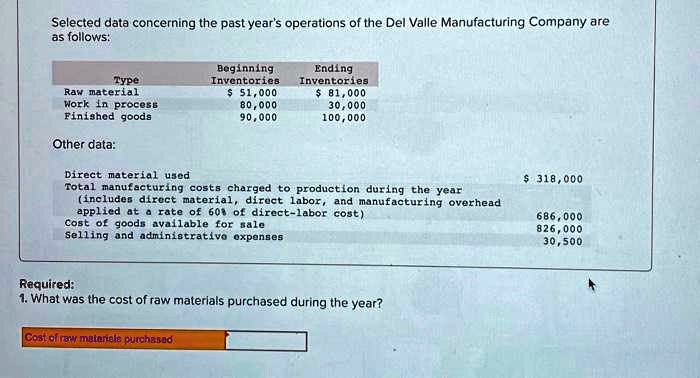
Selected data concerning the past year's operations of the Del Valle Manufacturing Company are as follows: Type Beginning Ending Inventories Inventories Raw material $ 51,000 $ 81,000 Work in process 80,000 30,000 Finished goods 90,000 100,000 Other data: Direct material used Total manufacturing costs charged to production during the year (includes direct material, direct labor, and manufacturing overhead applied at a rate of 60% of direct-labor cost) Cost of goods available for sale Selling and administrative expenses $ 318,000 686,000 826,000 30,500 Required: 1. What was the cost of raw materials purchased during the year? Cost of raw materials purchased
View Answer
divider
BEST MATCH

Click to see additional instructions What is the derivative function of $\pi = 3q^2 + 400$ ? $\pi' = $q+

View Answer
divider
BEST MATCH

Find v(t) given v(0) = 2V using Laplace transforms and node analysis i(t) 3 ohms 5 ohms -4u(t) V 2i(t) 1F v(t)

View Answer
divider
BEST MATCH

I want question number 6 solution. (b) Fu 5k SRIEU, 90 19- WM lok R8 R ch

View Answer
divider
BEST MATCH

Assignment 3 - 2018: Gas-Liquid Absorption 100 kmol/h of a gas stream containing 40 mol% NH3 (the rest is air) is to have 95% of the NH3 removed by counter-current absorption with a certain recycled absorption solution that enters containing 0.5 mol% NH3. Assume a constant temperature and pressure inside the column of 25°C and 1 atm respectively. Data: The equilibrium vapor concentration y* as a function of solution concentration x is given in the following table. Assume that the absorption liquid has a molecular weight of 40 g/mol, density of 1200 kg/m3, and viscosity of 0.002 Pa s. x (mol%) | y* (mol%) 0 | 0 1 | 1.2 2 | 2.9 3 | 5.4 4 | 8.6 5 | 12.9 6 | 19.5 7 | 27.6 8 | 37.3 8.2 | 40.0 a) Determine the minimum liquid flow rate needed to achieve the required separation. For parts (b) onwards, assume that an actual feed liquid flow rate of 488 kmol/h is to be used. b) Determine the exit gas and liquid compositions and flow rates. c) Determine the number of equilibrium stages needed to perform the required separation. d) If the Murphree stage efficiency is 80%, then determine the actual number of stages required. For parts (e) onwards, assume that a packed column (not a tray tower) is being used. The column is to be filled with 1.5 in. Interlox saddles. Assume that there is negligible liquid-phase resistance to mass transfer. e) Determine the number of overall mass transfer units required, based on the gas phase composition (Noy). f) Determine the column cross-sectional area and diameter at the flooding limit. g) If using an actual column cross-sectional area twice the minimum, then determine the total column height required.

View Answer
divider