Question 2
Dave Ltd manufactures glass for the construction industry. The company has two
production departments: Machining and Finishing. There are also two support
departments: Ordering and Design. The budgeted overhead costs for the year for each
department are as follows:
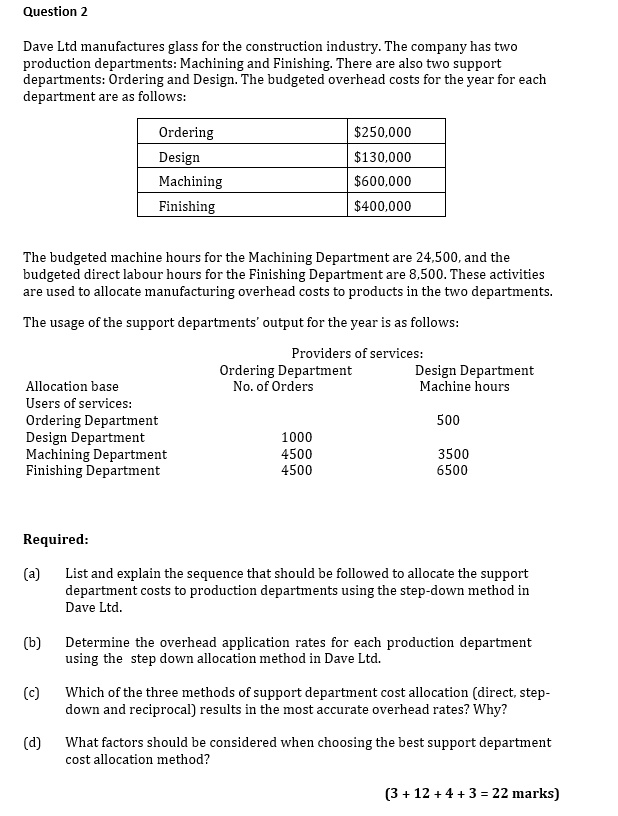
Ordering
$250,000
Design
$130,000
Machining
$600,000
Finishing
$400,000
The budgeted machine hours for the Machining Department are 24,500, and the
budgeted direct labour hours for the Finishing Department are 8,500. These activities
are used to allocate manufacturing overhead costs to products in the two departments.
The usage of the support departments' output for the year is as follows:
Providers of services:
Allocation base
Ordering Department
Design Department
No. of Orders
Machine hours
Users of services:
Ordering Department
500
Design Department
1000
Machining Department
4500
3500
Finishing Department
4500
6500
Required:
(a) List and explain the sequence that should be followed to allocate the support
department costs to production departments using the step-down method in
Dave Ltd.
(b) Determine the overhead application rates for each production department
using the step down allocation method in Dave Ltd.
(c) Which of the three methods of support department cost allocation (direct, step-
down and reciprocal) results in the most accurate overhead rates? Why?
(d) What factors should be considered when choosing the best support department
cost allocation method?
(3 + 12 + 4 + 3 = 22 marks)