Problem: Suppose you have just completed a capital expenditure analysis on the following proposal:
Your company is considering the purchase of a fleet of energy-efficient delivery trucks. The trucks will reduce annual expenses by $325,000. The trucks will require a total initial investment of $1 million. Their useful life is five years, at which time they will be sold for 10% of the original cost. For tax purposes, the trucks will be depreciated using MACRS and are classified as 5-year property. The investment will have no effect on net working capital. The cost of capital is 14% and the marginal tax rate is 35%.
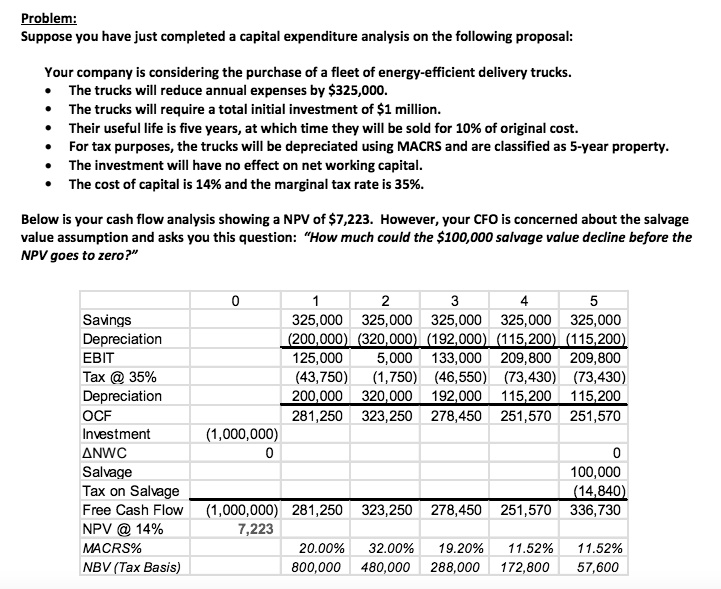
Below is your cash flow analysis showing an NPV of $7,223. However, your CFO is concerned about the salvage value assumption and asks you this question: "How much could the $100,000 salvage value decline before the NPV goes to zero?"
Savings Depreciation EBIT Tax @ 35% Depreciation OCF Investment NWC Salvage Tax on Salvage Free Cash Flow NPV @ 14% MACRS% NBV (Tax Basis)
325,000 325,000 325,000 325,000 325,000 200,000 (320,000) (192,000) (115,200) (115,200) 125,000 5,000 133,000 209,800 209,800 (43,750) 1,750 (46,550) (73,430) (73,430) 200,000 320,000 192,000 115,200 115,200 281,250 323,250 278,450 251,570 251,570 (1,000,000) 0 0 100,000 14,840 1,000,000 281,250 323,250 278,450 251,570 336,730 7,223 20.00% 32.00% 19.20% 11.52% 11.52% 800,000 480,000 288,000 172,800 57,600