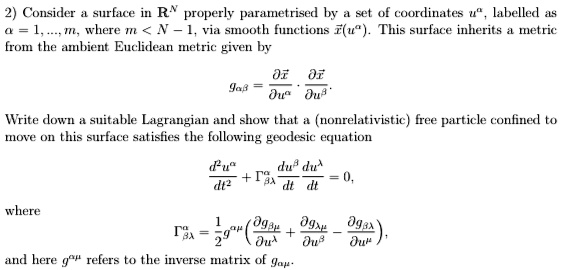
2) Consider a surface in $\mathbb{R}^N$ properly parametrised by a set of coordinates $u^\alpha$, labelled as $\alpha = 1, ..., m$, where $m < N - 1$, via smooth functions $\vec{x}(u^\alpha)$. This surface inherits a metric from the ambient Euclidean metric given by
$g_{\alpha\beta} = \frac{\partial \vec{x}}{\partial u^\alpha} \cdot \frac{\partial \vec{x}}{\partial u^\beta}$.
Write down a suitable Lagrangian and show that a (nonrelativistic) free particle confined to move on this surface satisfies the following geodesic equation
$\frac{d^2 u^\alpha}{dt^2} + \Gamma^\alpha_{\beta\lambda} \frac{du^\beta}{dt} \frac{du^\lambda}{dt} = 0$,
where
$\Gamma^\alpha_{\beta\lambda} = \frac{1}{2} g^{\alpha\mu} \left( \frac{\partial g_{\beta\mu}}{\partial u^\lambda} + \frac{\partial g_{\lambda\mu}}{\partial u^\beta} - \frac{\partial g_{\beta\lambda}}{\partial u^\mu} \right)$,
and here $g^{\alpha\mu}$ refers to the inverse matrix of $g_{\alpha\mu}$.