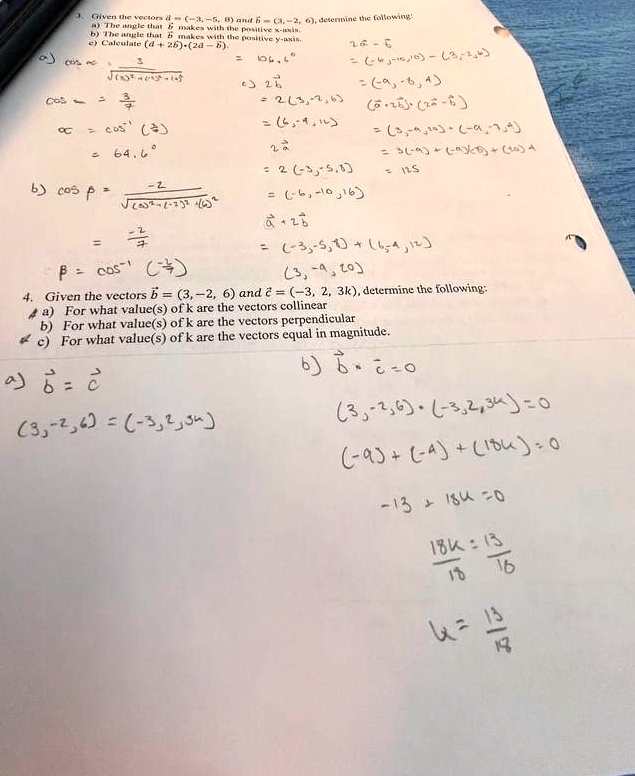
3. Given the vectors \(\vec{d} = (-3, -5, 8)\) and \(\vec{b} = (3, -2, 6)\), determine the following:
a) The angle that \(\vec{d}\) makes with the positive x-axis.
b) The angle that \(\vec{b}\) makes with the positive y-axis.
c) Calculate \((\vec{d} + 2\vec{b}) \cdot (2\vec{d} - \vec{b})\).
4. Given the vectors \(\vec{b} = (3, -2, 6)\) and \(\vec{c} = (-3, 2, 3k)\), determine the following:
a) For what value(s) of k are the vectors collinear
b) For what value(s) of k are the vectors perpendicular
c) For what value(s) of k are the vectors equal in magnitude.
a) \(\vec{b} = \vec{c}\)
\((3, -2, 6) = (-3, 2, 3k)\)
b) \(\vec{b} \cdot \vec{c} = 0\)
\((3, -2, 6) \cdot (-3, 2, 3k) = 0\)
\((-9) + (-4) + (18k) = 0\)
\(-13 + 18k = 0\)
\(18k = \frac{13}{18}\)
\(k = \frac{13}{18}\)