QUESTION 1
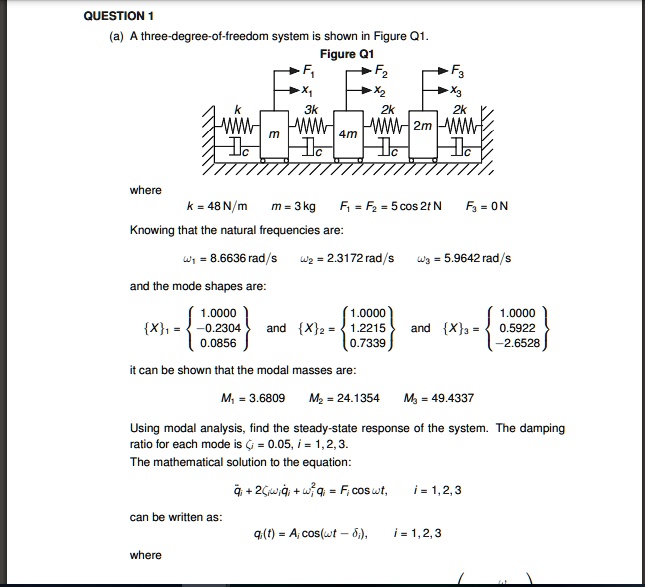
(a) A three-degree-of-freedom system is shown in Figure Q1.
Figure Q1
$F_1$
$x_1$
$F_2$
$x_2$
$F_3$
$x_3$
k
3k
2k
2k
m
4m
2m
where
$k = 48 N/m$
$m = 3 kg$
$F_1 = F_2 = 5 \cos 2t N$
$F_3 = 0 N$
Knowing that the natural frequencies are:
$\omega_1 = 8.6636 rad/s$
$\omega_2 = 2.3172 rad/s$
$\omega_3 = 5.9642 rad/s$
and the mode shapes are:
$\{X\}_1 = \begin{Bmatrix} 1.0000 \\ -0.2304 \\ 0.0856 \end{Bmatrix}$
and
$\{X\}_2 = \begin{Bmatrix} 1.0000 \\ 1.2215 \\ 0.7339 \end{Bmatrix}$
and
$\{X\}_3 = \begin{Bmatrix} 1.0000 \\ 0.5922 \\ -2.6528 \end{Bmatrix}$
it can be shown that the modal masses are:
$M_1 = 3.6809$
$M_2 = 24.1354$
$M_3 = 49.4337$
Using modal analysis, find the steady-state response of the system. The damping
ratio for each mode is $\zeta = 0.05$, $i = 1, 2, 3$.
The mathematical solution to the equation:
$\ddot{q}_i + 2\zeta_i\omega_i\dot{q}_i + \omega_i^2q_i = F_i \cos \omega t$,
$i = 1, 2, 3$
can be written as:
$q_i(t) = A_i \cos(\omega t - \delta_i)$,
$i = 1, 2, 3$
where