able[[Q:1,Trail,100ml Baker,100ml graduated cylinder,10mL graduated cylinder,5mL pipette,20-200 (mu )/() micropipettor,r 100-1000 mu I micropipettor],[,1,59.26,59.48,2.77,3.22,0.17,0.16],[,2,57.59,58.87,2.8,3.2,0.17,0.16],[,3,57.77,58.94,2.82,3.25,0.17,0.16],[,4,58.86,58.56,2.82,3.21,0.16,0.16],[,5,59.09,59.43,2.82,3.17,0.17,0.17],[,6,56.3,59.59,2.83,3.13,0.16,0.17],[,Average,58.145,59.145,2.81,3.196666667,0.1666666667,0.1633333333],[,Standard Deviation,0.7928571429,0.3042857143,0.01428571429,0.02666666667,0.00380952381,0.00380952381],[,Percent Error,6.166666667,0.6833333333,95.28333333,94.78333333,99.73333333,99.71666667]]
Q: 2 (A)
Examine the data and statistics for the two devices you used to measure 60mL.
a. Which of the two devices was the most accurate one? Explain your reasoning process for this conclusion, using your data or statistical tests to support your reasoning.
b. Which of the two devices was the most precise one? Explain your reasoning process for this conclusion, using your data or statistical tests to support your reasoning.
Examine the data and statistics for the two devices you used to measure 3mL.
a. Which of the two devices was the most accurate one? Explain your reasoning process for this conclusion, using your data or statistical tests to support your reasoning.
b. Which of the two devices was the most precise one? Explain your reasoning process for this conclusion, using your data or statistical tests to support your reasoning.
Examine the data and statistics for the two devices you used to measure 0.17mL.
a. Which of the two devices was the most accurate one? Explain your reasoning process for this conclusion, using your data or statistical tests to support your reasoning.
b. Which of the two devices was the most precise one? Explain your reasoning process for this conclusion, using your data or statistical tests to support your reasoning.
You need to measure 5mL of a liquid. Of the six devices you used in this lab, which one would you choose? Make your choice and explain your reasoning based upon the statistical analysis you did of the accuracy and precision of the six devices.
Note: Make a conclusion by choosing a device that is appropriate for this volume and is also supported by the statistical analyses of its accuracy and precision. This conclusion might not be what you expected, which is fine.
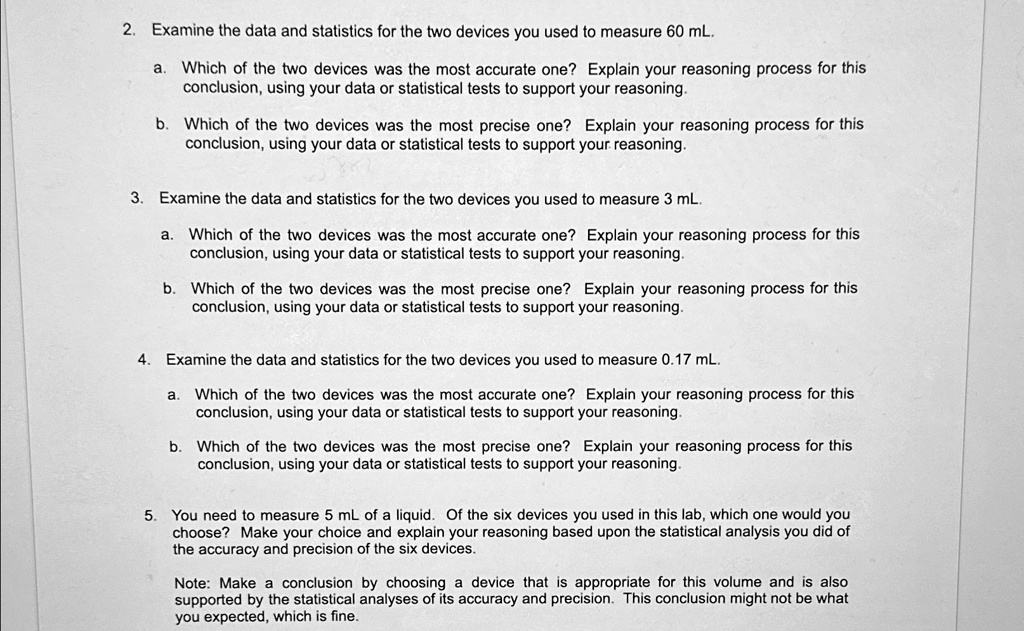
2.Examine the data and statistics for the two devices you used to measure 60 mL.
a.Which of the two devices was the most accurate one? Explain your reasoning process for this conclusion, using your data or statistical tests to support your reasoning.
b.Which of the two devices was the most precise one?Explain your reasoning process for this conclusion,using your data or statistical tests to support your reasoning
3. Examine the data and statistics for the two devices you used to measure 3 mL
a. Which of the two devices was the most accurate one? Explain your reasoning process for this conclusion,using your data or statistical tests to support your reasoning
b.Which of the two devices was the most precise one? Explain your reasoning process for this conclusion, using your data or statistical tests to support your reasoning
4. Examine the data and statistics for the two devices you used to measure 0.17 mL
a.Which of the two devices was the most accurate one? Explain your reasoning process for this conclusion, using your data or statistical tests to support your reasoning.
b.Which of the two devices was the most precise one?Explain your reasoning process for this conclusion,using your data or statistical tests to support your reasoning.
5. You need to measure 5 mL of a liquid. Of the six devices you used in this lab,which one would you choose? Make your choice and explain your reasoning based upon the statistical analysis you did of the accuracy and precision of the six devices.
Note: Make a conclusion by choosing a device that is appropriate for this volume and is also supported by the statistical analyses of its accuracy and precision. This conclusion might not be what you expected,which is fine.