Prove the following theorems:
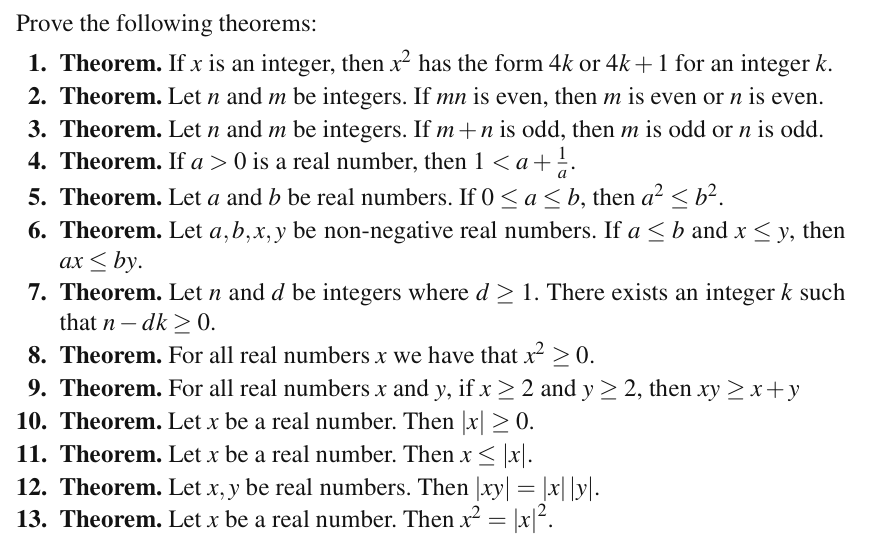
1. Theorem. If \( x \) is an integer, then \( x^{2} \) has the form \( 4 k \) or \( 4 k+1 \) for an integer \( k \).
2. Theorem. Let \( n \) and \( m \) be integers. If \( m n \) is even, then \( m \) is even or \( n \) is even.
3. Theorem. Let \( n \) and \( m \) be integers. If \( m+n \) is odd, then \( m \) is odd or \( n \) is odd.
4. Theorem. If \( a>0 \) is a real number, then \( 1<a+\frac{1}{a} \).
5. Theorem. Let \( a \) and \( b \) be real numbers. If \( 0 \leq a \leq b \), then \( a^{2} \leq b^{2} \).
6. Theorem. Let \( a, b, x, y \) be non-negative real numbers. If \( a \leq b \) and \( x \leq y \), then \( a x \leq b y \).
7. Theorem. Let \( n \) and \( d \) be integers where \( d \geq 1 \). There exists an integer \( k \) such that \( n-d k \geq 0 \).
8. Theorem. For all real numbers \( x \) we have that \( x^{2} \geq 0 \).
9. Theorem. For all real numbers \( x \) and \( y \), if \( x \geq 2 \) and \( y \geq 2 \), then \( x y \geq x+y \)
10. Theorem. Let \( x \) be a real number. Then \( |x| \geq 0 \).
11. Theorem. Let \( x \) be a real number. Then \( x \leq|x| \).
12. Theorem. Let \( x, y \) be real numbers. Then \( |x y|=|x||y| \).
13. Theorem. Let \( x \) be a real number. Then \( x^{2}=|x|^{2} \).