Ace - AI Tutor
Ask Our Educators
Textbooks
My Library
Flashcards
Scribe - AI Notes
Notes & Exams
Download App
ashley blackwell

ashley b.

Divider

Questions asked

BEST MATCH

In what way do phenoxy radicals formed from antioxidants differ from other radicals? They are more reactive and cause cellular damage They are more stable and less reactive They regenerate antioxidants They form unstable intermediates that promote oxidation

View Answer
divider
BEST MATCH

The current population of India is 1129866154 with a relative growth rate of 1.606%. If indias population continues to grow at this rate, when will India's population double in size

View Answer
divider
BEST MATCH

1.11. Which one of the following is not true about the intermolecular interaction between water and polassium ions. A. The interaction is known as the ion-dipole interaction. B. The strength of the interaction depends on the charge and size of the ion and one hand and on the magnitude of the dipole. C. It is known as the ion-induced dipole interaction D. It results into hydration of the potassium ions. 1.12. A solution of a particular concentration is prepared at \( 20^{\circ} \mathrm{C} \). Which of the following does change when the solution is heated to \( 75^{\circ} \mathrm{C} \) ? A. Molarity B. Molality C. Percent by mass D. All of these change 1.13. Which one describes a solution whose solvent holds less solute than is normally possible at a given temperature. A. unsaturated B. desaturated C. supersaturated D. saturated 1.14. Which one of the following is not true about vapour pressure? A. vapour pressure is the pressure exerted by the vapour of a liquid at liquidvapour equilibrium. B. Liquids with London forces have high vapour pressure. C. vapour pressure is high at high temperatures. D. liquids with hydrogen bonding in them have high vapour pressure. 1.15. The Boiling point of the halogens: A. Increase down the group B. Remains constant C. decrease down the group D. Can't be predicted 1.16. Chemical kinetics, a branch of physical chemistry, deals with: A. heat changes in a reaction B. physical changes in a reaction C. rates of reactions D. structure of molectiles Page 5 of 13

View Answer
divider
BEST MATCH

Apps C. CPS Apps Prayer Journal Pri... Google Google Accounts G Image result for sa.. VINELink ver. 2.0 Offender Search :... G AT\&T treble reble 2.0 ? Chemistry Sem 1 Pretest: Unit 5 1 Point Whic Ace Al Tuto ? Apex Learning Question 18 of 30 What is the cell potential of an electrochemical cell that has the half-reactions shown below? \[ \begin{array}{l} \mathrm{Ni}^{2+}+2 \mathrm{e}^{-} \rightarrow \mathrm{Ni} \\ \mathrm{Al} \rightarrow \mathrm{Al}^{3+}+3 \mathrm{e}^{-} \end{array} \] Click for a reduction potential chart A. \( -1.43 \mathrm{~V} \) B. \( 1.43 \mathrm{~V} \) C. \( -1.93 \mathrm{~V} \) D. \( 2.61 \mathrm{~V} \) PREVIOUS \begin{tabular}{|c|c|} \hline Half-Reaction & \begin{tabular}{l} Standard Reduction \\ Potential (Volts), \( E^{\circ} \) \end{tabular} \\ \hline \( \mathrm{Au}^{+}(a q)+\mathrm{e}^{-} \rightarrow \mathrm{Au}(s) \) & 1.83 \\ \hline \( \mathrm{Hg}^{2+}(\mathrm{aq})+2 \mathrm{e}^{-} \rightarrow \mathrm{Hg}(h) \) & 0.85 \\ \hline \( \mathrm{Ag}^{+}(a q)+\mathrm{e}^{*} \rightarrow \mathrm{Ag}(\mathrm{s}) \) & 0.80 \\ \hline \( \mathrm{Fe}^{3+}(\mathrm{aq})+\mathrm{e}^{-} \rightarrow \mathrm{Fe}^{2+}(\mathrm{aq}) \) & 0.77 \\ \hline \( \mathrm{Cu}^{2+}(\mathrm{aq})+2 \mathrm{e}^{-} \rightarrow \mathrm{Cu}(s) \) & 0.34 \\ \hline \( 2 \mathrm{H}^{\prime}(\mathrm{aq})+2 \mathrm{e}^{*} \rightarrow \mathrm{H}_{2}(g) \) & 0.00 \\ \hline \( \mathrm{Fe}^{2+}(a q)+2 \mathrm{e}^{-} \rightarrow \mathrm{Fe}(s) \) & -0.04 \\ \hline \( \mathrm{N}^{2+}(\mathrm{sq})+2 \mathrm{e}^{-} \rightarrow \mathrm{N} i(s) \) & -0.25 \\ \hline \( \mathrm{Fe}^{3+}(\mathrm{aq})+3 \mathrm{e}^{-} \rightarrow \mathrm{Fe}(\mathrm{s}) \) & -0.44 \\ \hline \( \mathrm{Zn}^{2+}(a q)+2 \mathrm{e}^{-} \rightarrow \mathrm{Zn}(s) \) & -0.76 \\ \hline \( \mathrm{AN}^{3+}(\mathrm{aq})+3 \mathrm{e}^{-} \rightarrow \mathrm{A}(\mathrm{s}) \) & -1.68 \\ \hline \( \mathrm{Mg}^{2+}(a q)+2 \mathrm{e}^{-} \rightarrow \mathrm{Mg}(s) \) & -2.37 \\ \hline \( \mathrm{Na}^{+}(a q)+\mathrm{e}^{-} \rightarrow \mathrm{Na}(s) \) & -2.71 \\ \hline \( \mathrm{K}^{*}(a q)+\mathrm{e}^{-} \rightarrow \mathrm{K}(s) \) & -2.80 \\ \hline \( \mathrm{L}^{+}(\mathrm{aq})+\mathrm{e}^{-} \rightarrow \mathrm{L}(\mathrm{s}) \) & 3.05 \\ \hline \end{tabular}

View Answer
divider
BEST MATCH

Which layer of the three tiered model is most likely to feature large amounts of security and world balancing and is also often responsible for setting policy

View Answer
divider
BEST MATCH

How many gas molecules are present in 671 mL of propane (C3H8) at 27 °C and 334 torr pressure? x 10 molecules How many atoms are present? x 10 atoms What would the volume of the sample be at STP? L

View Answer
divider
BEST MATCH

9. A sign is mounted to a solid circular post as shown in the figure. Assume the post is rigidly buried in the ground to a depth of 3 ft. The weight of the sign is 500 lbs. The weight of the post is also significant. A wind produces a positive uniformly distributed pressure of 1 psi on the front of the sign and the post. The sign is rigidly connected to the post and the stresses at the sign/post interface can be assumed to be non-critical. The sign and the post have the following properties. Determine the safety factor for the given design. The material is a ductile steel where the tensile and compressive yield strengths are equal. The most accurate failure theory should be used. (10 pts) Post $E = 30e6$ psi Poission's ratio = 0.3 Outside Diameter = 4 inches Density = 0.289 lb/in³ Sign $E = 30e6$ psi Poisson's ratio =0.3 Ground Level 3 ft Top View Wind Direction 4 inches 2 ft y Front View x 9 ft Wind Direction 7 ft Side View A = 2.315 B = 2.365 C = 2.395 D = 2.435 E = Other specify

View Answer
divider
BEST MATCH

The block shown below is subjected to a force of P= 300sin5t N. If the mass of the block (m) is 10kg, the spring stiffness (k) is 300 N/m and the damping coefficient C is 200 N.s/m: A) Draw the free-body-diagram (4 marks). B) Calculate the natural frequency (3 marks). C) Calculate the damping ratio ($\zeta$) (3 marks). D) Determine the steady-state response of the system as a function of time (4 marks).

View Answer
divider
BEST MATCH

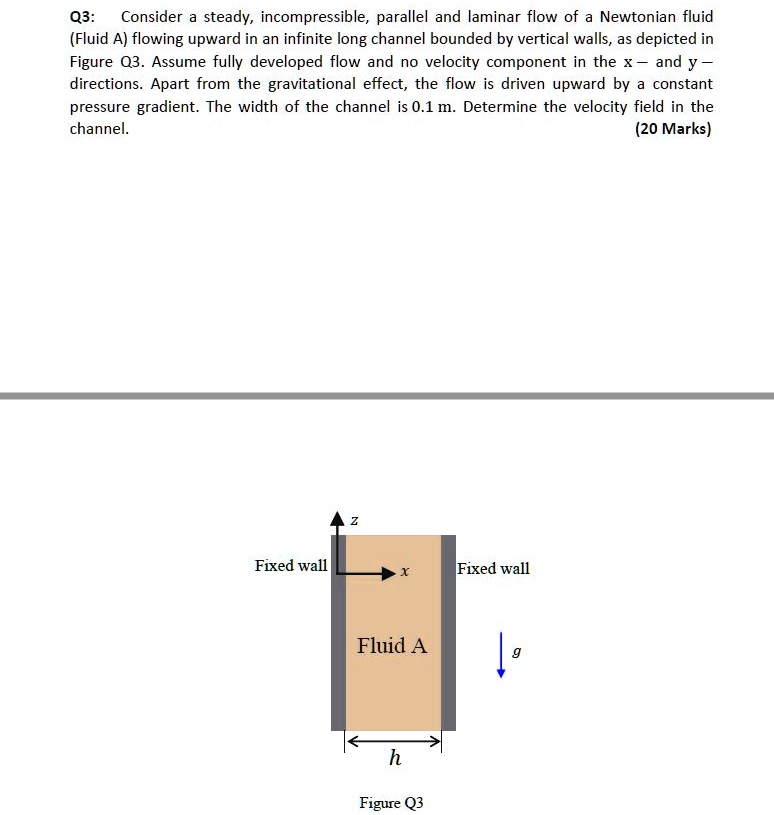
Q3: Consider a steady, incompressible, parallel and laminar flow of a Newtonian fluid (Fluid A) flowing upward in an infinite long channel bounded by vertical walls, as depicted in Figure Q3. Assume fully developed flow and no velocity component in the x and y - directions. Apart from the gravitational effect, the flow is driven upward by a constant pressure gradient. The width of the channel is 0.1 m. Determine the velocity field in the channel. (20 Marks) Fixed wall z x Fixed wall Fluid A g h Figure Q3
View Answer
divider
BEST MATCH

Outline the pathophysiology of heart failure and explain how a history of heart attacks can result in chronic heart failure

View Answer
divider