Ace - AI Tutor
Ask Our Educators
Textbooks
My Library
Flashcards
Scribe - AI Notes
Notes & Exams
Download App
ashley calderon

ashley c.

Divider

Questions asked

BEST MATCH

Select all that apply to type II diabetes mellitus [mark all correct answers] a. most type II diabetic are overweight b. produce insulin, but receptors are less responsive c. make up 5-10% of the patients with diabetes d. patients develop ketoacidosis e. most patients are diagnosed in their teens

View Answer
divider
BEST MATCH

How is the angle made by CBA, arctan(12/15)? Shouldnt it be arctan(5/12)?

View Answer
divider
BEST MATCH

What are organisms that optimally grow at pH levels less than 5.5 considered? Acidophiles Alkallphiles Hypothermophiles Neutrophiles

View Answer
divider
BEST MATCH

Describe Type 2 diabetes and make sure you include the following concepts, hormone sensitivity and up or down-regulation.

View Answer
divider
BEST MATCH

1. Find the resultant vectors of these vectors as shown: y B 3.00 2.00 A 60.0° x 20.0° 4.00 C

View Answer
divider
BEST MATCH

How many ounces of sugar-sweetened soft drinks do adolescent boys consume each day at school? Group of answer choices 26 20 8 24 12

View Answer
divider
BEST MATCH

Type up the program below and get it working. Then add the following functions/methods/actions: void insertFirst(int number_to_add) - assumes array is big enough, inserts element at index 0, and then shifts all others to the right. void deleteNumber(int number_to_delete) - If a number is found, delete that element and shifts all others to the left (deletes 1 number max) void sort() - sorts the array using bubble sort that we learned in CSIS45 Call each function from the main, and test your program. Show all test results at the bottom of your code using /* */ !!! #include <iostream> using namespace std; class EncapsulatedArray { private: int *array; // Dynamically allocated array int number_of_elements; public: EncapsulatedArray(int size); void add(int number_to_add); void show(); }; EncapsulatedArray::EncapsulatedArray(int size) { number_of_elements = 0; array = new int[size]; } void EncapsulatedArray::add(int number_to_add) { array[number_of_elements] = number_to_add; number_of_elements++; } void EncapsulatedArray::show() { if (number_of_elements == 1) { cout << "{ " << array[0] << " } "; return; } cout << "{ "; for (int i = 0; i < number_of_elements - 1; i++) { cout << array[i] << ", "; } cout << array[number_of_elements - 1] << " } "; } int main() { EncapsulatedArray anArray(5); anArray.add(9); anArray.show(); anArray.add(101); anArray.add(9); anArray.show(); }

View Answer
divider
BEST MATCH

The master budget at Cherrylawn Corporation at the beginning of the year was based on sales of 283,500 units with revenues of $3,402,000. Total variable costs were budgeted at $1,984,500 and fixed costs at $984,000. During the period, actual production and actual sales were 256,700 units. The actual revenues were $3,451,000. Actual variable costs were $5.65 per unit. Actual fixed costs were $1,014,000. Required: Prepare a profit variance analysis. Note: Indicate the effect of each variance by selecting "F" for favorable, or "U" for unfavorable. If there is no effect, do not select either option. Sales revenue Less: Variable costs Contribution margin Less: Fixed costs Operating profits Cherrylawn Corporation Profit Variance Analysis Actual Manufacturing Variances Sales Price Variance Flexible Budget Sales Activity Variance Master Budget $ 0 $ 0 $ 0 0 $ 0

View Answer
divider
BEST MATCH

Question 6: Evaluate A) $\int_0^{\sqrt{\pi}} \int_0^2 \int_0^z x^2 \sin y \, dy \, dz \, dx$

View Answer
divider
BEST MATCH

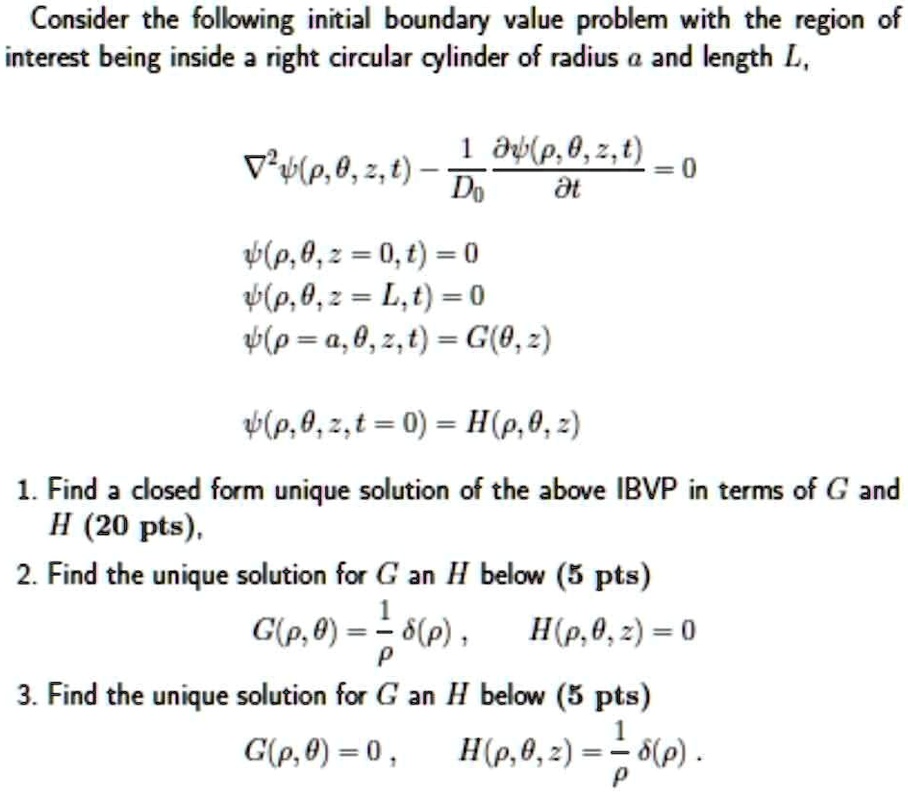
Consider the following initial boundary value problem with the region of interest being inside a right circular cylinder of radius $a$ and length $L$, $\nabla^2 \psi(\rho, \theta, z, t) - \frac{1}{D_0} \frac{\partial \psi(\rho, \theta, z, t)}{\partial t} = 0$ $\psi(\rho, \theta, z = 0, t) = 0$ $\psi(\rho, \theta, z = L, t) = 0$ $\psi(\rho = a, \theta, z, t) = G(\theta, z)$ $\psi(\rho, \theta, z, t = 0) = H(\rho, \theta, z)$ 1. Find a closed form unique solution of the above IBVP in terms of $G$ and $H$ (20 pts), 2. Find the unique solution for $G$ an $H$ below (5 pts) $G(\rho, \theta) = \frac{1}{\rho} \delta(\rho)$, $H(\rho, \theta, z) = 0$ 3. Find the unique solution for $G$ an $H$ below (5 pts) $G(\rho, \theta) = 0$, $H(\rho, \theta, z) = \frac{1}{\rho} \delta(\rho)$.
View Answer
divider