Problem 1
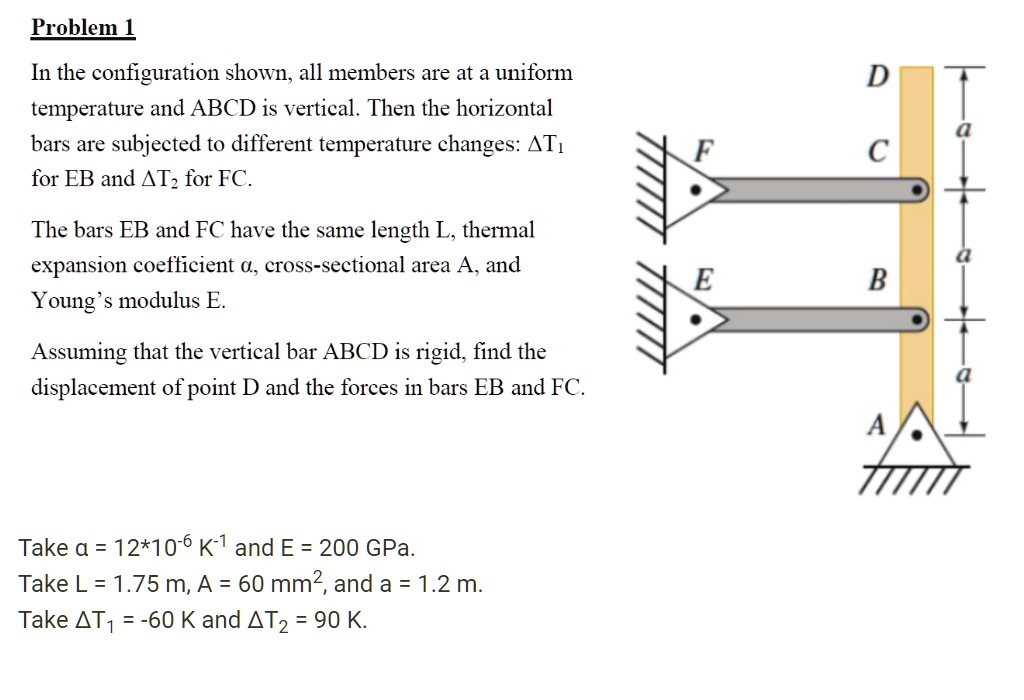
In the configuration shown, all members are at a uniform
temperature and ABCD is vertical. Then the horizontal
bars are subjected to different temperature changes: \(\Delta T_1\)
for EB and \(\Delta T_2\) for FC.
The bars EB and FC have the same length L, thermal
expansion coefficient \(\alpha\), cross-sectional area A, and
Young's modulus E.
Assuming that the vertical bar ABCD is rigid, find the
displacement of point D and the forces in bars EB and FC.
Take \(\alpha = 12 \times 10^{-6} K^{-1}\) and \(E = 200 \text{ GPa}\).
Take \(L = 1.75 \text{ m}\), \(A = 60 \text{ mm}^2\), and \(a = 1.2 \text{ m}\).
Take \(\Delta T_1 = -60 \text{ K}\) and \(\Delta T_2 = 90 \text{ K}\).