An insulated metal rod has length L and diameter D. An electric heating element is embedded
in the rod. When electric power is supplied to the heating element, it generates heat uniformly
along the length of the rod at a rate S [W/m³]. Initially, the rod is at a uniform temperature To
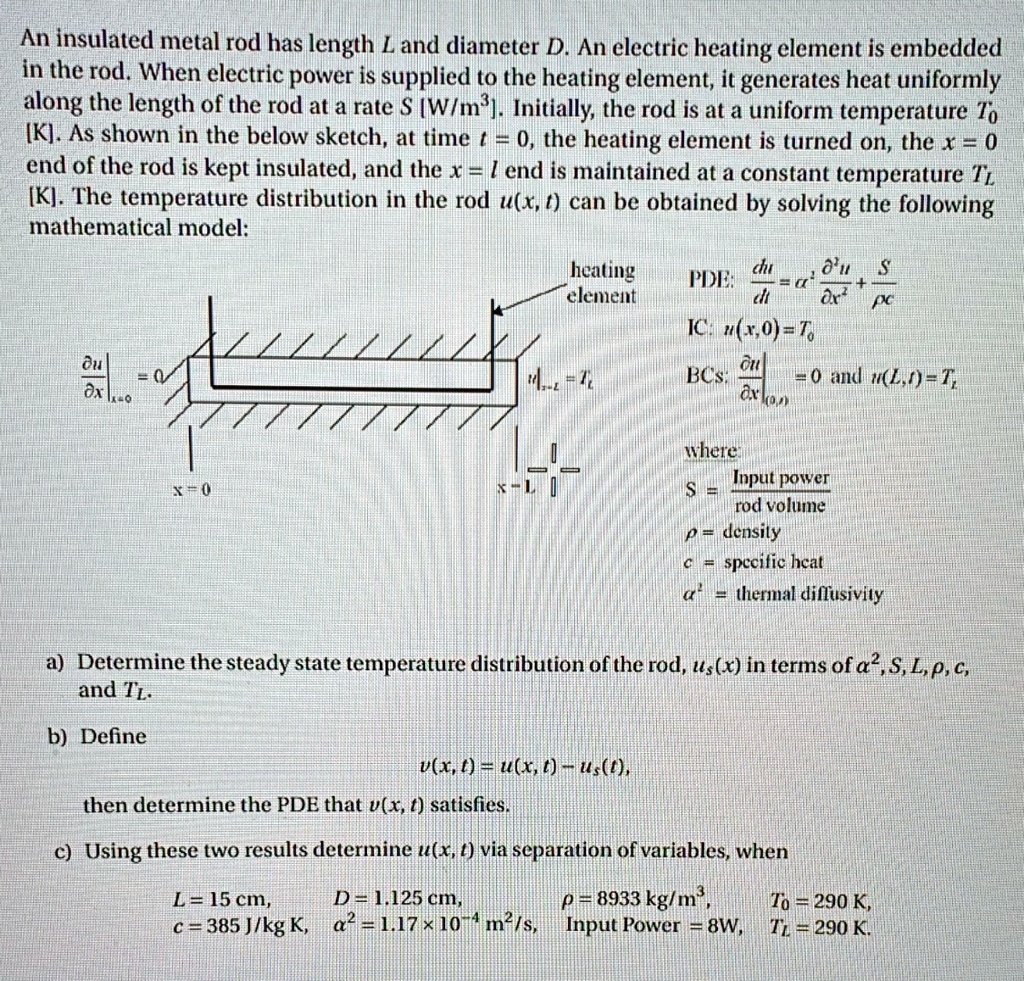
[K]. As shown in the below sketch, at time t = 0, the heating element is turned on, the x = 0
end of the rod is kept insulated, and the x = I end is maintained at a constant temperature TL
[K]. The temperature distribution in the rod u(x, t) can be obtained by solving the following
mathematical model:
$$
\frac{\partial u}{\partial t} = a^2 \frac{\partial^2 u}{\partial x^2} + \frac{S}{\rho c}
$$
$$
\frac{\partial u}{\partial x}|_{x=0} = 0
$$
$$
u(x,0) = T_0
$$
$$
\frac{\partial u}{\partial x}|_{x=L} = 0
$$
$$
u(L,t) = T_L
$$
where:
S = Input power
p = rod volume
density
c = specific heat
a² = thermal diffusivity
a) Determine the steady state temperature distribution of the rod, us(x) in terms of a², S, L, p, c,
and TL.
b) Define
$$
v(x, t) = u(x, t) - u_s(t),
$$
then determine the PDE that v(x, t) satisfies.
c) Using these two results determine u(x, t) via separation of variables, when
L = 15 cm,
D=1.125 cm,
p = 8933 kg/m³,
Το = 290 K,
c = 385 J/kg K, a² = 1.17 × 10⁻⁴ m²/s, Input Power = 8W, T₁ = 290 Κ.