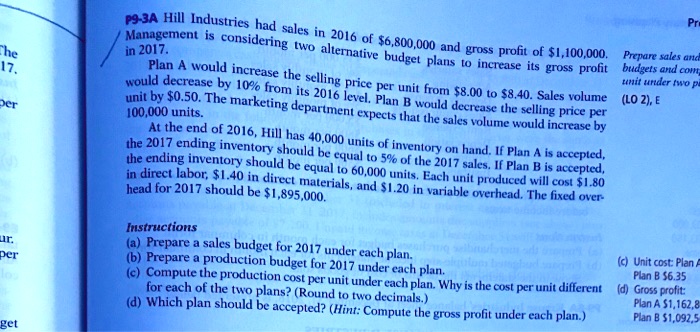
P9-3A Hill Industries had sales in 2016 of $6,800,000 and gross profit of $1,100,000.
Management is considering two alternative budget plans to increase its gross profit
in 2017.
Plan A would increase the selling price per unit from $8.00 to $8.40. Sales volume
would decrease by 10% from its 2016 level. Plan B would decrease the selling price per
unit by $0.50. The marketing department expects that the sales volume would increase by
100,000 units.
At the end of 2016, Hill has 40,000 units of inventory on hand. If Plan A is accepted,
the 2017 ending inventory should be equal to 5% of the 2017 sales. If Plan B is accepted,
the ending inventory should be equal to 60,000 units. Each unit produced will cost $1.80
in direct labor, $1.40 in direct materials, and $1.20 in variable overhead. The fixed over
head for 2017 should be $1,895,000.
Instructions
(a) Prepare a sales budget for 2017 under each plan.
(b) Prepare a production budget for 2017 under each plan.
(c) Compute the production cost per unit under each plan. Why is the cost per unit different
for each of the two plans? (Round to two decimals.)
(d) Which plan should be accepted? (Hint: Compute the gross profit under each plan.)