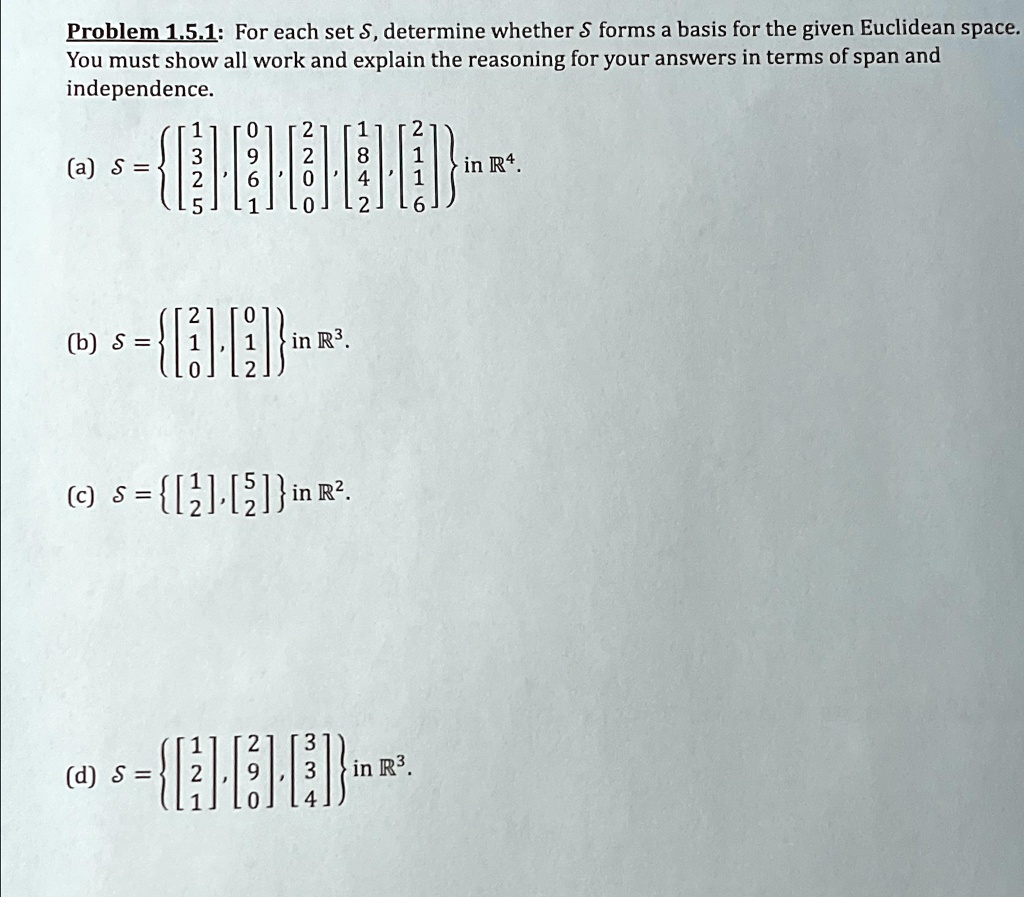
Problem 1.5.1: For each set S, determine whether S forms a basis for the given Euclidean space.
You must show all work and explain the reasoning for your answers in terms of span and
independence.
\begin{equation*}
(a) \quad S = \left\{ \begin{bmatrix} 1 \ 3 \ 2 \ 5 \end{bmatrix}, \begin{bmatrix} 0 \ 9 \ 6 \ 1 \end{bmatrix}, \begin{bmatrix} 2 \ 2 \ 0 \ 0 \end{bmatrix}, \begin{bmatrix} 1 \ 8 \ 4 \ 2 \end{bmatrix}, \begin{bmatrix} 1 \ 1 \ 1 \ 6 \end{bmatrix} \right\} \text{ in } \mathbb{R}^4.
\end{equation*}
\begin{equation*}
(b) \quad S = \left\{ \begin{bmatrix} 2 \ 1 \ 0 \end{bmatrix}, \begin{bmatrix} 0 \ 1 \ 2 \end{bmatrix} \right\} \text{ in } \mathbb{R}^3.
\end{equation*}
\begin{equation*}
(c) \quad S = \left\{ \begin{bmatrix} 1 \ 2 \end{bmatrix}, \begin{bmatrix} 5 \ 2 \end{bmatrix} \right\} \text{ in } \mathbb{R}^2.
\end{equation*}
\begin{equation*}
(d) \quad S = \left\{ \begin{bmatrix} 1 \ 2 \ 1 \end{bmatrix}, \begin{bmatrix} 2 \ 9 \ 0 \end{bmatrix}, \begin{bmatrix} 3 \ 3 \ 4 \end{bmatrix} \right\} \text{ in } \mathbb{R}^3.
\end{equation*}