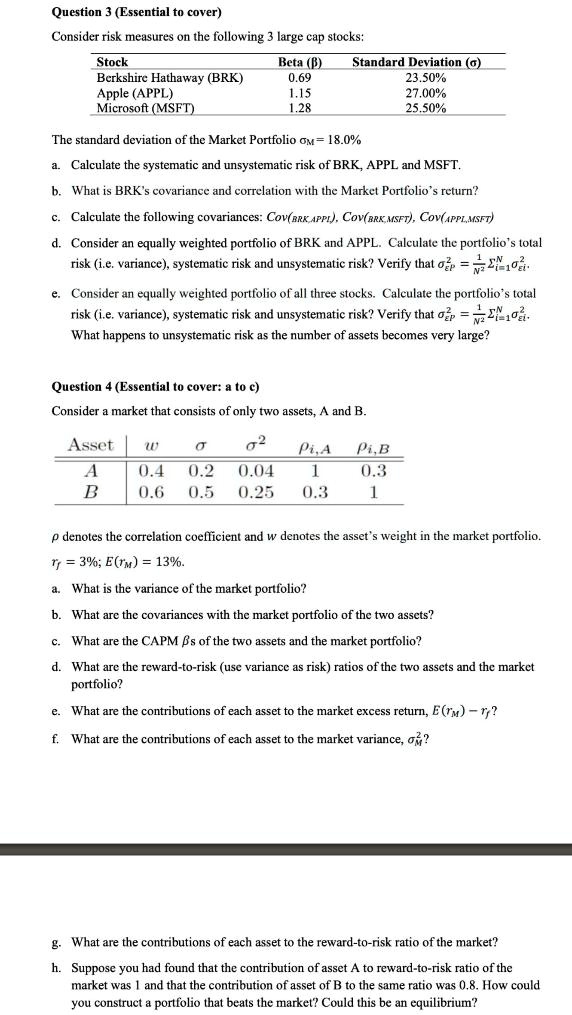
Question 3 (Essential to cover)
Consider risk measures on the following 3 large cap stocks:
Stock Berkshire Hathaway (BRK), Apple (AAPL), Microsoft (MSFT)
Beta: 0.69, 1.15, 1.28
Standard Deviation: 23.50%, 27.00%, 25.50%
The standard deviation of the Market Portfolio (oM) = 18.0%
a. Calculate the systematic and unsystematic risk of BRK, AAPL, and MSFT.
b. What is BRK's covariance and correlation with the Market Portfolio's return?
Calculate the following covariances: Cov(BRK, AAPL), Cov(BRK, MSFT), Cov(AAPL, MSFT)
d. Consider an equally weighted portfolio of BRK and AAPL. Calculate the portfolio's total risk, i.e. variance, systematic risk, and unsystematic risk. Verify that p=
e. Consider an equally weighted portfolio of all three stocks. Calculate the portfolio's total risk, i.e. variance, systematic risk, and unsystematic risk. Verify that p=
What happens to unsystematic risk as the number of assets becomes very large?
Question 4 (Essential to cover: a to c)
Consider a market that consists of only two assets, A and B.
Asset w a 02 Pi,A Pi,B A 0.4 0.2 0.04 1 0.3 B 0.6 0.5 0.25 0.3 1
denotes the correlation coefficient and w denotes the asset's weight in the market portfolio.
ErM = 13%. What is the variance of the market portfolio?
b. What are the covariances with the market portfolio of the two assets?
c. What are the CAPM s of the two assets and the market portfolio?
d. What are the reward-to-risk (use variance as risk) ratios of the two assets and the market portfolio?
What are the contributions of each asset to the market excess return, ErM-r?
f. What are the contributions of each asset to the market variance?
g. What are the contributions of each asset to the reward-to-risk ratio of the market?
h. Suppose you had found that the contribution of asset A to the reward-to-risk ratio of the market was 1 and that the contribution of asset B to the same ratio was 0.8. How could you construct a portfolio that beats the market? Could this be an equilibrium?