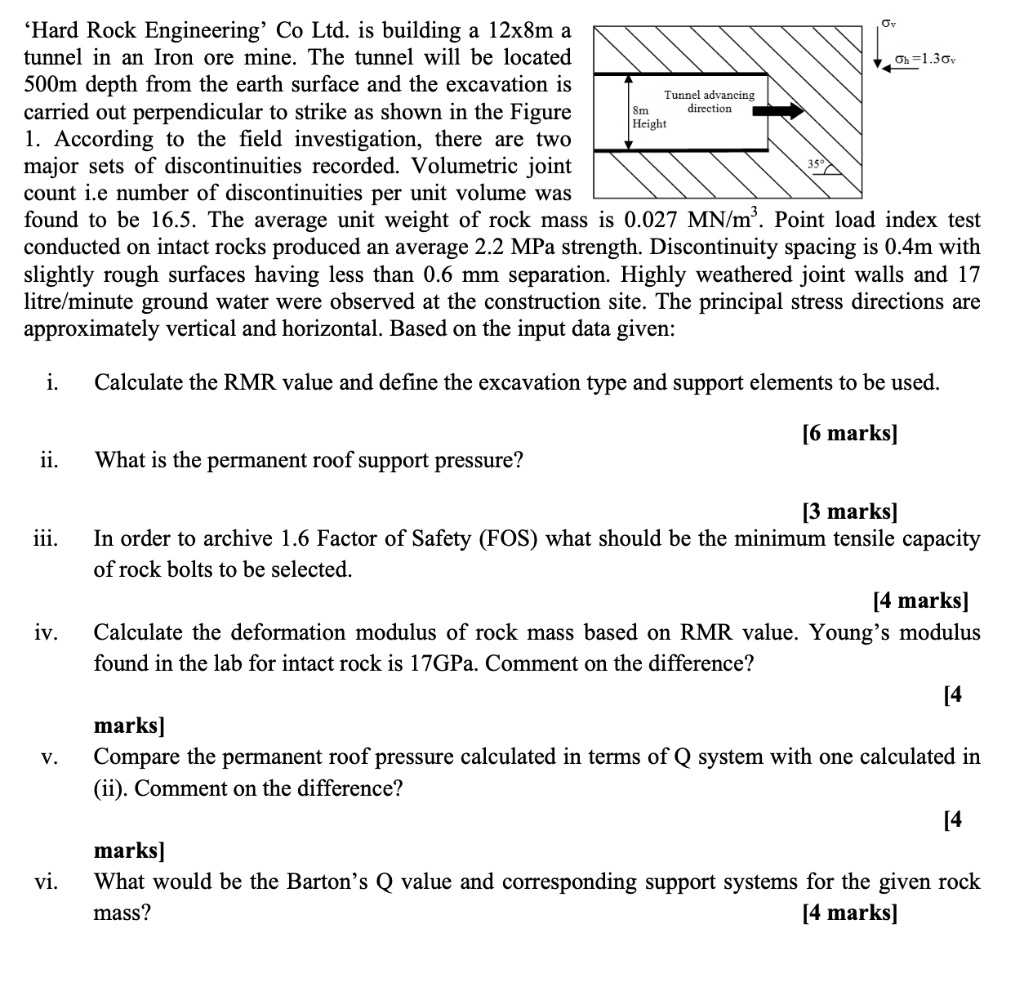
Hard Rock Engineering Co. Ltd. is building a 12x8m tunnel in an Iron ore mine. The tunnel will be located at a depth of 1.3m from the earth's surface and the excavation is carried out perpendicular to the strike direction as shown in the Figure. According to the field investigation, there are two major sets of discontinuities recorded. The volumetric joint count, i.e., the number of discontinuities per unit volume, was found to be 16.5. The average unit weight of the rock mass is 0.027 MN/m3. Point load index tests conducted on intact rocks produced an average strength of 2.2 MPa. The discontinuity spacing is 0.4m with slightly rough surfaces having less than 0.6 mm separation. Highly weathered joint walls and 17 liters/minute of groundwater were observed at the construction site. The principal stress directions are approximately vertical and horizontal.
Based on the input data given:
i. Calculate the RMR value and define the excavation type and support elements to be used. [6 marks]
ii. What is the permanent roof support pressure? [3 marks]
iii. In order to achieve a Factor of Safety (FOS) of 1.6, what should be the minimum tensile capacity of rock bolts to be selected? [4 marks]
iv. Calculate the deformation modulus of the rock mass based on the RMR value. Young's modulus found in the lab for intact rock is 17 GPa. Comment on the difference? [4 marks]
v. Compare the permanent roof pressure calculated in terms of the Q system with the one calculated in (ii). Comment on the difference? [4 marks]
vi. What would be the Barton's Q value and corresponding support systems for the given rock mass? [4 marks]