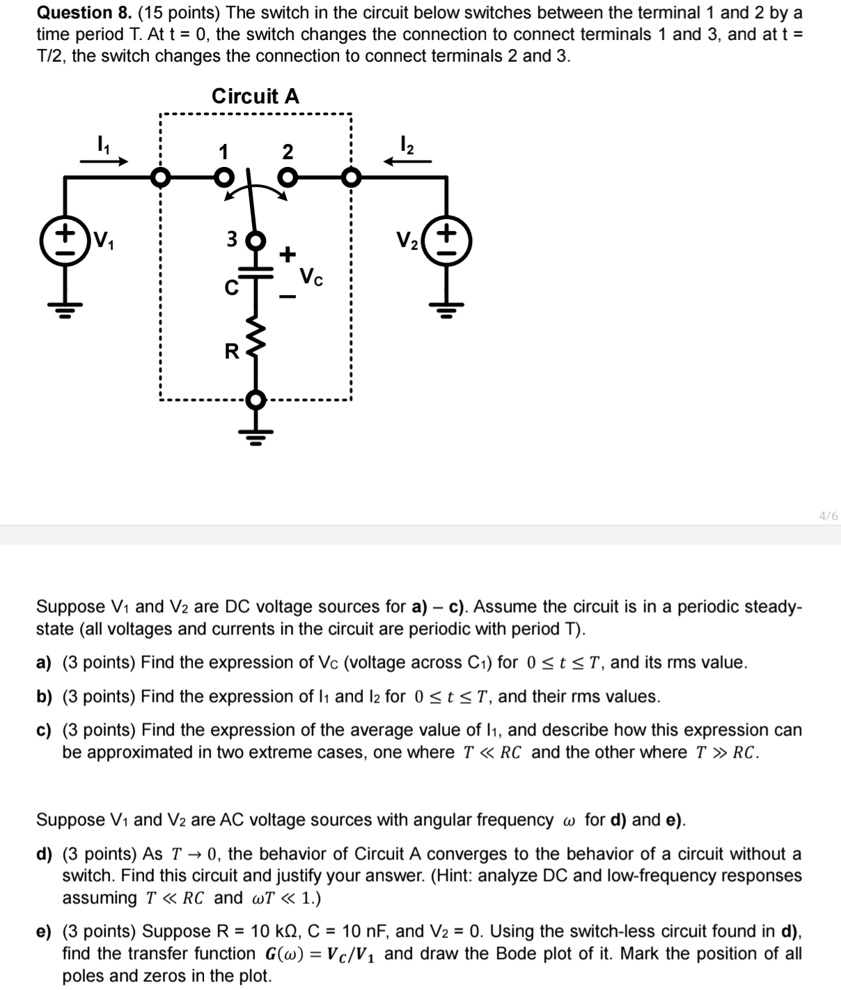
Question 8. (15 points) The switch in the circuit below switches between the terminal 1 and 2 by a time period T. At t = 0, the switch changes the connection to connect terminals 1 and 3, and at t = T/2, the switch changes the connection to connect terminals 2 and 3.
Circuit A
$$I_1$$
$$V_1$$
$$I_2$$
$$V_2$$
$$V_C$$
C
R
Suppose $$V_1$$ and $$V_2$$ are DC voltage sources for a) – c). Assume the circuit is in a periodic steady- state (all voltages and currents in the circuit are periodic with period T).
a) (3 points) Find the expression of $$V_C$$ (voltage across $$C_1$$) for $$0 \le t \le T$$, and its rms value.
b) (3 points) Find the expression of $$I_1$$ and $$I_2$$ for $$0 \le t \le T$$, and their rms values.
c) (3 points) Find the expression of the average value of $$I_1$$, and describe how this expression can be approximated in two extreme cases, one where $$T \ll RC$$ and the other where $$T \gg RC$$.
Suppose $$V_1$$ and $$V_2$$ are AC voltage sources with angular frequency $$\omega$$ for d) and e).
d) (3 points) As $$T \to 0$$, the behavior of Circuit A converges to the behavior of a circuit without a switch. Find this circuit and justify your answer. (Hint: analyze DC and low-frequency responses assuming $$T \ll RC$$ and $$\omega T \ll 1$$.)
e) (3 points) Suppose R = 10 k$$\Omega$$, C = 10 nF, and $$V_2 = 0$$. Using the switch-less circuit found in d), find the transfer function $$G(\omega) = V_C/V_1$$ and draw the Bode plot of it. Mark the position of all poles and zeros in the plot.