Hello, please answer all questions 1 to 10. I need the answers today. Thank you in advance.
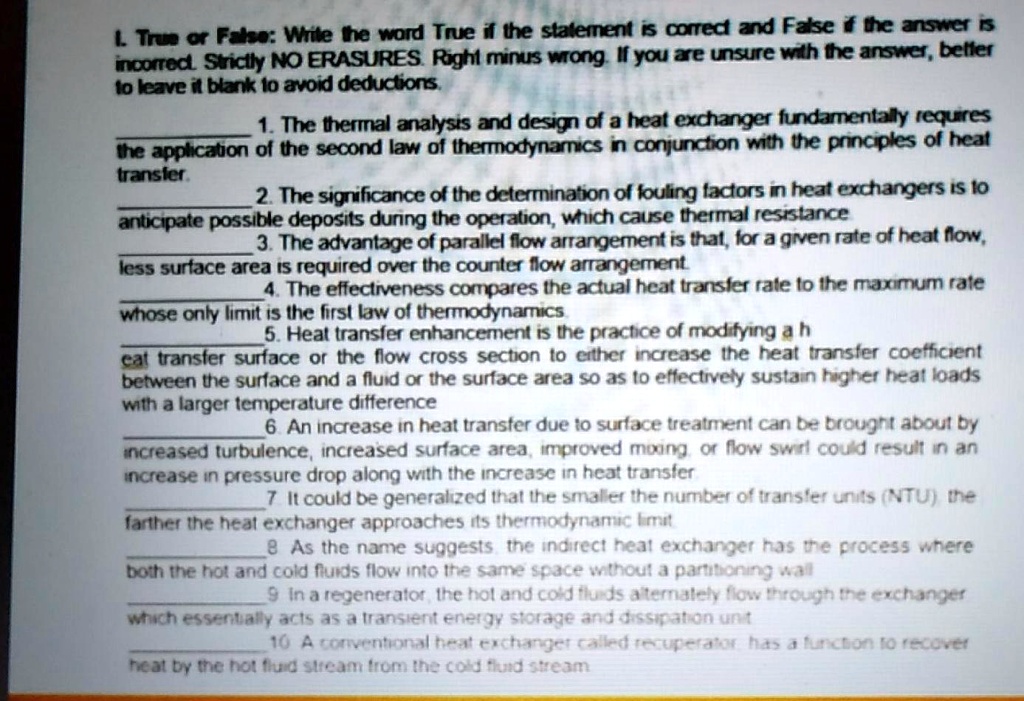
I. True or False. Write the word "True" if the statement is correct and "False" if the answer is incorrect. Strictly NO ERASURES. Right minus wrong. If you are unsure of the answer, it is better to leave it blank to avoid deductions.
1. The thermal analysis and design of a heat exchanger fundamentally requires the application of the second law of thermodynamics in conjunction with the principles of heat transfer.
2. The significance of the determination of fouling factors in heat exchangers is to anticipate possible deposits during the operation, which cause thermal resistance.
3. The advantage of parallel flow arrangement is that, for a given rate of heat flow, less surface area is required compared to the counter flow arrangement.
4. The effectiveness compares the actual heat transfer rate to the maximum rate, with the only limit being the first law of thermodynamics.
5. Heat transfer enhancement is the practice of modifying a heat transfer surface or the flow cross-section to either increase the heat transfer coefficient between the surface and a fluid or increase the surface area to effectively sustain higher heat loads with a larger temperature difference.
6. An increase in heat transfer due to surface treatment can be brought about by increased turbulence, increased surface area, improved mixing, or flow swirl. This could result in an increase in pressure drop along with the increase in heat transfer.
7. It could be generalized that the smaller the number of transfer units (NTU), the closer the heat exchanger approaches its thermodynamic limit.
8. As the name suggests, the indirect heat exchanger has a process where both the hot and cold fluids flow into the same space without a partitioning wall.
9. In a regenerator, the hot and cold fluids alternately flow through the exchanger, which essentially acts as a transient energy storage and dissipation unit.
10. A conventional heat exchanger called a recuperator has the function to recover heat from the hot fluid stream to the cold fluid stream.